A Little English Gallery
Louise Imogen Guiney’s Lyrical, Erudite Portraits of Forgotten Cavaliers, Metaphysical Mystics, and Restoration Dramatists
In the late nineteenth century, while academic literary scholarship was stiffening into dry philology and industrial utilitarianism was dominating public culture, an American woman living between Boston and Oxford waged a solitary, brilliant campaign to rescue the soul of English letters. Louise Imogen Guiney (1861–1920)—poet, essayist, Roman Catholic scholar, and devoted archivist of the Caroline and Jacobean eras—published A Little English Gallery in 1894 as part of Harper’s American Essayists series.
It remains one of the most exquisite volumes of literary biography in the English language. Rather than treating her subjects as museum relics or fodder for academic deconstruction, Guiney approached them as living kindred spirits. With aristocratic elegance, infectious wit, and archival precision, she painted five unforgettable biographical miniatures: Lady Danvers (mother of John Donne and George Herbert), Henry Vaughan the Silurist, George Farquhar, Topham Beauclerk and Bennet Langton (Boswell’s companions), and William Hazlitt.
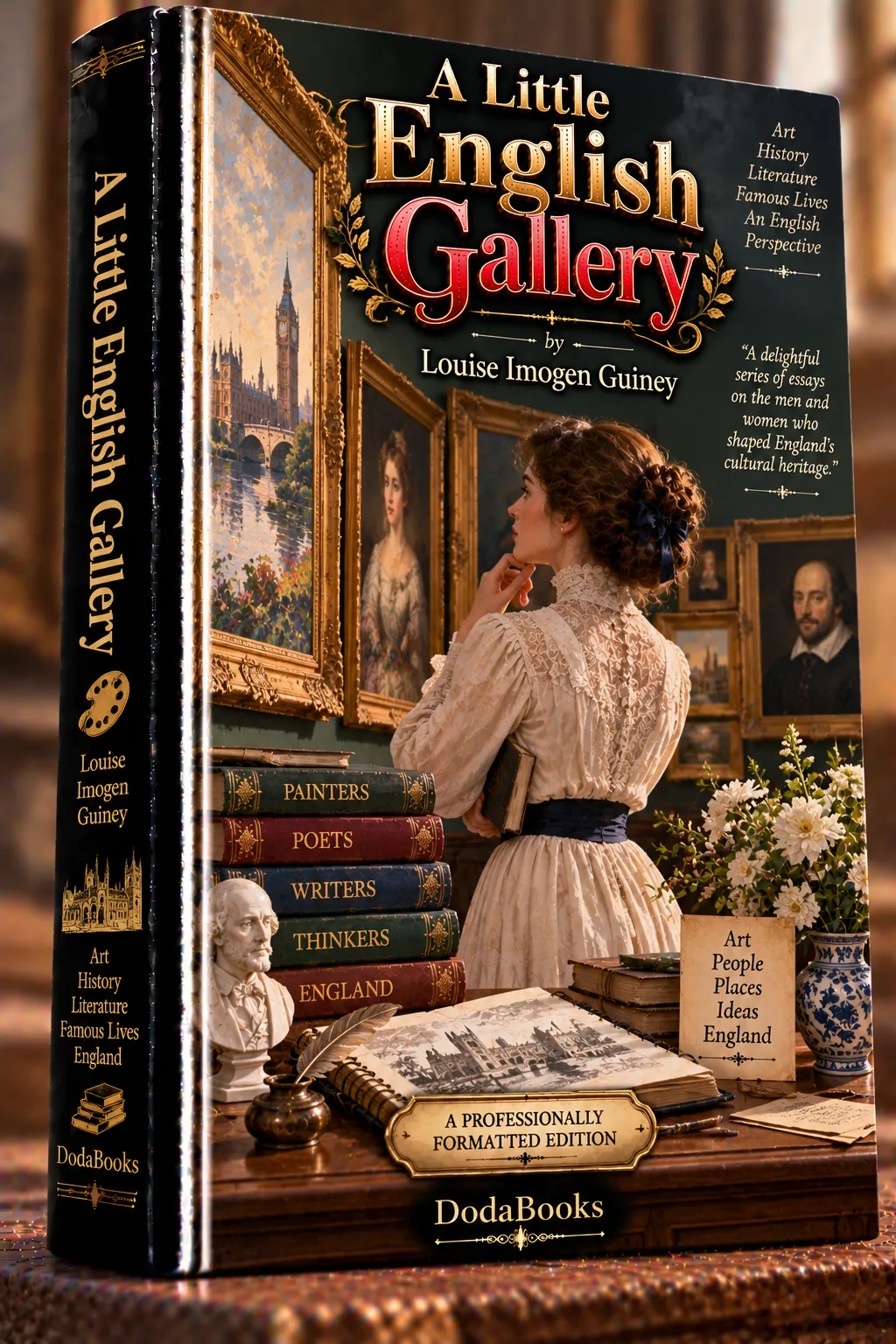
Rediscover Louise Imogen Guiney's Lyrical Portraits
Read the definitive edition of A Little English Gallery, accompanied by historical notes elucidating 17th-century devotional poetry, Restoration theatre, and Oxford archival discoveries.
Get A Little English GalleryThe Five Portraits: An Intellectual Gallery Walk
Guiney structures her collection like an intimate gallery of Renaissance portraits, each capturing the moral essence and artistic temperament of figures who lived with chivalric courage in turbulent times:
1. Lady Danvers (Magdalen Herbert)
The collection opens with a magnificent tribute to Magdalen Herbert, later Lady Danvers (d. 1627)—the brilliant, saintly mother of the metaphysical poet George Herbert and philosopher Lord Herbert of Cherbury, and the lifelong patroness and muse of John Donne. Guiney paints her as the supreme embodiment of Jacobean maternal grace, classical learning, and unshakeable religious charity.
2. Henry Vaughan the Silurist
Guiney’s essay on the Welsh metaphysical poet Henry Vaughan (1621–1695) is widely regarded by scholars as the catalyst for the modern recovery of Vaughan’s poetry. While Victorian critics largely neglected Vaughan in favor of George Herbert, Guiney recognized Vaughan’s mystical communion with nature, his Platonic visions of childhood innocence, and his fierce loyalty to King Charles I during the English Civil War.
3. George Farquhar
Turning from seventeenth-century mysticism to Restoration comedy, Guiney provides a compassionate, sparkling defense of the Irish playwright George Farquhar (1677–1707). Author of The Beaux’ Stratagem and The Recruiting Officer, Farquhar lived in chronic poverty and died young, yet poured boundless sunshine, genial good humor, and humane warmth into the often cynical English stage.
4. Topham Beauclerk and Bennet Langton
A masterclass in double biography, this essay examines the devoted friendship between two young aristocrats who became the beloved intimates of Dr. Samuel Johnson. Guiney contrasts Beauclerk’s lazy, acid-tongued wit with Langton’s gentle, towering scholarly piety, celebrating the bond that united them around Johnson’s Literary Club.
5. William Hazlitt
The final portrait is a fierce, empathetic appraisal of the great Romantic essayist and critic William Hazlitt (1778–1830). Guiney does not conceal Hazlitt’s difficult, prickly temper or his political obstinacy; instead, she celebrates his uncompromising intellectual honesty, his incandescent prose style, and his tragic romantic vulnerability.
The Belletristic Prose of Louise Imogen Guiney
What makes reading Guiney an intoxicating aesthetic experience is her prose style. She belonged to the grand tradition of English belletrists—sharing aesthetic lineage with Charles Lamb, Robert Louis Stevenson, and Walter Pater. Her sentences are compact, muscular, and steeped in seventeenth-century cadence, yet sparkling with modern psychological clarity:
“To love Vaughan is to love dawn, silence, and the mountain wind. He does not preach; he listens to the quiet footstep of eternity walking among the Brecon hills, and sets the sound to music for weary mortals.”
Guiney rejected the cynical commercialism of the Gilded Age. For her, literature was a sacred vocation—a chivalric defense of beauty, honor, and spiritual contemplation against the noisy encroaching machinery of modern mass society.
Landmark Literary Recovery
The groundbreaking critical collection that spearheaded the 1890s revival of Henry Vaughan and shed new light on Restoration dramatist George Farquhar.
Exquisite Belletristic Prose
A masterclass in the English essay, blending 17th-century rhetorical richness with Victorian wit, warmth, and biographical intimacy.
Boswellian Intimacy
Brilliant behind-the-scenes portraits of Dr. Samuel Johnson's circle, revealing the private lives of Topham Beauclerk and Bennet Langton.
Scholarly Explanatory Footnotes
Comprehensive annotations explaining Cavalier politics, Jacobean religious liturgy, Georgian London clubs, and Guiney's Oxford research.
The Life of an American Expatriate in Oxford
Louise Imogen Guiney’s own life was as romantic and courageous as any of the figures she profiled. The daughter of General Patrick Robert Guiney, an Irish-American hero of the Civil War who died young from battle wounds, Louise grew up in Boston surrounded by books. Appointed postmistress of Auburndale, Massachusetts, she faced vicious anti-Catholic boycotts from bigoted local factions, which she met with serene dignity before resigning to devote herself entirely to archival research.
In 1901, she relocated permanently to England, spending the remainder of her life working among the manuscripts of the Bodleian Library in Oxford. Living in voluntary poverty and wearing out her eyesight over crumbling seventeenth-century folios, Guiney was a pioneering female scholar in an era when women were barred from formal academic appointments at Oxford.
Step Inside the Quiet Sanctuary of English Letters
Read Louise Imogen Guiney's brilliant critical essays in an exquisitely formatted digital edition with scholarly footnotes and biographical commentary.
Get A Little English Gallery on DodaBooksThe Recusant Imagination and Caroline Devotion
To understand Guiney’s profound affinity for seventeenth-century poets, one must examine her unique vantage point as a devout Roman Catholic scholar exploring post-Reformation England. In the late Victorian era, British literary history was heavily filtered through Whig Protestant historiography, which tended to celebrate the Puritan triumph of Oliver Cromwell while dismissing Royalist Cavaliers and Catholic recusants as frivolous or decadent.
Guiney overturned this narrative by highlighting the profound spiritual depth of the Caroline poets:
- Sacramental Vision of Nature: In her study of Henry Vaughan, Guiney demonstrated how Vaughan’s Anglican-Royalist seclusion in the Usk Valley fostered a sacramental view of the natural world. Every wildflower, stone, and morning star became an epiphany of divine presence—a poetic theology that directly anticipated William Wordsworth by more than a century.
- The Crucible of Defeat: Guiney was fascinated by how poets responded to political and military defeat. When the Royalist cause was crushed in the Civil War, poets like Vaughan did not surrender to despair; they turned inward, discovering in prayer, mystical meditation, and rural solitude a spiritual liberty that no parliamentary army could take away.
- Ecumenical Generosity: While fiercely proud of her Catholic faith, Guiney celebrated spiritual integrity wherever she found it. She wrote with equal reverence of the Anglican piety of George Herbert and Dr. Samuel Johnson, the fiery Unitarian radicalism of William Hazlitt, and the quiet charity of Lady Danvers, proving that true art transcends sectarian divisions.
Why Modern Readers Need Guiney’s Vision
In a modern digital landscape dominated by hasty hot-takes, algorithmic reviews, and disposable cultural commentary, Louise Imogen Guiney’s essays stand as a luminous refuge. She reminds us that true literary criticism is an act of love—a patient, generous communion between the living reader and the noble dead.
Whether she is reconstructing a rowdy evening at the Drury Lane theatre with George Farquhar, walking the dew-drenched Welsh hills with Henry Vaughan, or defending William Hazlitt against Tory reviewers, Guiney writes with an emotional warmth and intellectual brilliance that leaves the reader permanently enriched.
The Enduring Charm of the Literary Miniature
Guiney's essays demonstrate that a concise, perfectly crafted biographical portrait can reveal more about human nature and artistic genius than a thousand pages of dry academic analysis.
The Annotations in the DodaBooks Edition
The DodaBooks curated edition of A Little English Gallery includes:
- Biographical Glossary of 17th- & 18th-Century Figures: Identifying dozens of poets, statesmen, bishops, and actors mentioned throughout the essays.
- Theological & Historical Context: Explanations of the Caroline divine tradition, the Welsh recusant community, and the English Civil War.
- Biographical Introduction to Guiney: An essay tracing Guiney’s heroic scholarship at the Bodleian Library and her influence on twentieth-century metaphysical poetry criticism.
Own the Definitive Digital Edition
Download A Little English Gallery today and discover one of the most brilliant and charming essay collections of the Victorian era.
Download the Edition NowFrequently Asked Questions
Who was Louise Imogen Guiney?
Louise Imogen Guiney (1861–1920) was an American poet, essayist, and scholar from Boston who lived much of her life in Oxford, England. She was a pioneering female researcher at the Bodleian Library celebrated for her belletristic prose and her scholarship on 17th-century English metaphysical and Cavalier poets.
Who are the five historical figures profiled in A Little English Gallery?
The collection profiles five figures: Lady Danvers (Magdalen Herbert, mother of George Herbert and friend of John Donne), Henry Vaughan the Silurist (Welsh metaphysical poet), George Farquhar (Restoration comedic playwright), Topham Beauclerk and Bennet Langton (friends of Dr. Samuel Johnson), and William Hazlitt (Romantic critic).
Why is Guiney's essay on Henry Vaughan historically significant?
Guiney's essay on Henry Vaughan was one of the first major critical works to revive the Welsh poet's reputation in modern literary history, establishing his stature alongside George Herbert and John Donne as one of the supreme mystical poets in the English language.
What style of writing characterizes this collection?
Guiney wrote in the belletristic essay tradition, characterized by lyrical cadence, erudite classical and historical allusions, gentle humor, and deep psychological sympathy for her biographical subjects.
Where can I purchase the complete annotated ebook?
The complete digital edition is available for immediate download at DodaBooks at https://dodabooks.com/ebook/a-little-english-gallery-by-louise-imogen-guiney/.