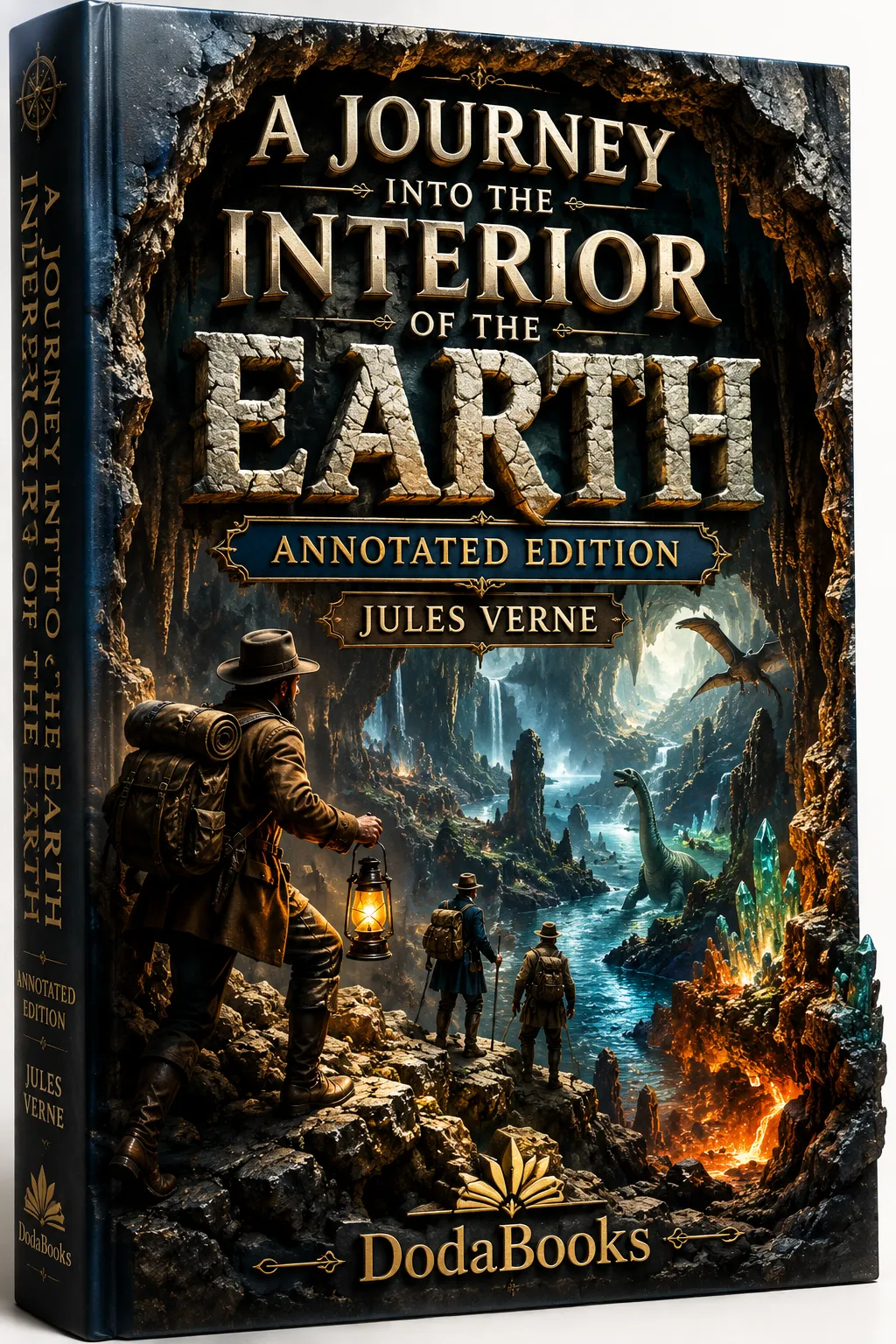
Jules Verne’s A Journey into the Interior of the Earth (Voyage au centre de la Terre, 1864) is one of the supreme founding monuments of science fiction and adventure literature. Chronicling the perilous descent of eccentric German polymath Professor Otto Lidenbrock, his cautious nephew Axel, and stoic Icelandic guide Hans into the bowels of an extinct volcanic crater, this thrilling epic captures the boundless scientific optimism, prehistoric wonder, and visionary imagination of the 19th century.
🌋
A Journey into the Interior of the Earth
The pioneering subterranean odyssey that defined science fiction adventure. Descend through the icy crater of Snæfellsjökull into an underground world of vast oceans, prehistoric monsters, and giant mushroom forests.
| Author | Jules Verne |
| Published | November 25, 1864 (Pierre-Jules Hetzel, Paris) |
| Genre | Science Fiction, Subterranean Fiction, Geological Adventure |
| Structure | 44 Chapters |
| Setting | Hamburg, Germany; Iceland (Snæfellsjökull); Subterranean World; Stromboli, Italy |
| Central Themes | The Triumph of Scientific Inquiry, Deep Time & Paleontology, Man vs. Primeval Nature, Reason vs. Panic |
| Reading Time | 6–8 hours |
| Summary Time | 20 minutes |
🔬 The Birth of the “Voyages Extraordinaires”
In the early 1860s, Paris was gripped by an unprecedented scientific revolution. Discoveries in paleontology, geology (Sir Charles Lyell’s Principles of Geology), and evolutionary biology (Charles Darwin’s On the Origin of Species, 1859) were radically redrawing humanity’s understanding of the age of the Earth. Extinct prehistoric monsters, subterranean strata, and ancient human tool fossils were overturning traditional biblical timelines.
French author Jules Verne (1828–1905) seized upon this thrilling intellectual revolution. Partnering with visionary Paris publisher Pierre-Jules Hetzel, Verne conceived of the Voyages Extraordinaires—a monumental series of scientifically grounded adventure novels designed to “summarize all the geographical, geological, physical, and astronomical knowledge amassed by modern science.”
Following the triumph of Five Weeks in a Balloon (1863), Verne turned his gaze downward into the unexplored subterranean depths of the planet. Drawing upon cutting-edge 19th-century geological debates—specifically challenging the prevailing “central heat theory” which assumed the Earth’s core was a molten inferno—Verne created an audacious adventure where the history of life on Earth is preserved like living fossils beneath the crust.
📖 The Subterranean Odyssey: Narrative Breakdown
The Runic Cryptogram of Arne Saknussemm (Chapters 1–6)
The novel opens in May 1863 in the old house of Professor Otto Lidenbrock on the Königstrasse in Hamburg. Lidenbrock, an eccentric, fiery-tempered professor of mineralogy, rushes home with an ancient Icelandic manuscript: Snorri Sturluson’s Heimskringla. Tucked inside the binding, Lidenbrock discovers a scrap of parchment covered in mysterious runic ciphers.
When Lidenbrock and his cautious nephew and assistant, Axel, decode the Latin cryptogram, they uncover an astonishing message written by 16th-century Icelandic alchemist Arne Saknussemm:
"Descend, bold traveler, into the crater of the jokul of Sneffels,
which the shadow of Scartaris touches before the kalends of July,
and you will reach the center of the earth. I have done it. Arne Saknussemm."
Electrified by the revelation, Lidenbrock packs scientific instruments—barometers, Ruhmkorff electric lanterns, compasses—and forces a terrified, reluctant Axel to accompany him.
Across Iceland to the Gates of the Abyss (Chapters 7–16)
Arriving in Reykjavik, Lidenbrock hires Hans Bjelke, a stoic, impassive Icelandic eiderdown hunter, as their guide. The expedition treks across the desolate, volcanic Icelandic landscape to the glacier-crowned peak of Snæfellsjökull. On the final days of June, the shadow of Mount Scartaris points to the middle of three chimneys inside the extinct crater. The travelers rope themselves together and descend into the black abyss.
The Trial of the Lidenbrock Sea (Chapters 17–34)
Descending thousands of feet into the subterranean dark, the explorers endure terrible hardships. They run out of water, facing imminent death until faithful Hans uses his pickaxe to tap into a subterranean boiling stream—dubbed the “Hansbach”—which cools into a life-saving fresh water supply. In a terrifying episode, Axel is separated from his companions in a labyrinth of pitch-black corridors, nearly succumbing to sensory deprivation before Lidenbrock’s voice is carried through acoustic acoustic stone channels.
Reunited, they emerge into a staggering subterranean world: an enormous cavern illuminated by an electric auroral haze, featuring a vast subterranean ocean: the Lidenbrock Sea. Along the coast, they marvel at forests of giant mushrooms, fifty-foot tree-ferns, and colossal lycopods from the Carboniferous epoch.
Constructing a raft from petrified wood, they set sail across the subterranean ocean. In one of the most famous chapters in science fiction, their raft is caught in a titanic battle between two gargantuan prehistoric marine reptiles: an Ichthyosaurus and a Plesiosaurus. The forty-foot monsters clash with primeval fury until the Ichthyosaurus tears its rival to shreds.
The Primeval Giant and the Final Eruption (Chapters 35–44)
Surviving an electrical subterranean hurricane that tosses their raft onto a coast of bones, the travelers discover an ossuary containing skeletons of mastodons, woolly mammoths, and a fossilized human skull from the Quaternary period. Peering through a primeval forest, Axel and Lidenbrock are stunned to witness a living, twelve-foot-tall prehistoric human giant herding a flock of mastodons with a tree branch. Fleeing in awe, they discover Arne Saknussemm’s initials carved onto a dark rock opening.
Finding their path blocked by a colossal granite rockfall, Lidenbrock uses gunpowder to blast the obstruction open. The blast shatters the cavern wall, unleashing a catastrophic abyss that swallows the entire Lidenbrock Sea, sucking their raft down a roaring subterranean vortex.
Trapped in a volcanic chimney, the water meets rising magma, converting their raft into a piston propelled upward by an erupting volcano. In a dazzling climax, the three explorers are ejected out of the crater of Stromboli into the sunlit Mediterranean Sea off the coast of Sicily! Celebrated across Europe, Lidenbrock achieves immortal scientific fame, and Axel marries his beloved sweetheart Graüben in Hamburg.
👥 Character Profiles & Dynamics
🌋 PROFESSOR OTTO LIDENBROCK
The Indomitable Scientific Monomaniac
“Science, my boy, is made of errors, but they are errors which it is good to make, because they lead little by little to the truth.”
Fiery, stubborn, brilliant, and possessed of boundless energy, Lidenbrock refuses to let physical exhaustion, starvation, or scientific orthodoxy halt his quest.
Why He Matters
Lidenbrock is the archetypal 19th-century scientific explorer, embodying humanity’s restless drive to conquer the unknown through reason and grit.
📖 AXEL (THE NARRATOR)
The Voice of Prudence and Reason
“I had a presentiment of disaster. To venture into the bowels of the earth—was it not an act of madness?”
Axel is cautious, romantic, easily frightened, yet scientifically perceptive. His first-person narration grounds the fantastical subterranean marvels in authentic human vulnerability.
Why He Matters
Axel represents the reader’s common sense, providing the emotional bridge between comfortable domestic sanity and terrifying existential danger.
🧊 HANS BJELKE
The Incorruptible Icelandic Pillar
“Hans was incapable of fear, incapable of enthusiasm, incapable of surprise. He was the rock upon which our salvation rested.”
Silent, physically tireless, and unflappable, Hans saves the expedition repeatedly through practical survival skills and unswerving loyalty.
Why He Matters
Hans represents pragmatic indigenous knowledge and physical stoicism, without which theoretical science would perish in the wilderness.
📘 Annotated Insight — Verne’s Ruhmkorff lamp—an early electric lantern powered by a Bunsen battery and induction coil—was real cutting-edge technology invented in 1855. By equipping his travelers with electric light rather than conventional torches, Verne avoided the danger of igniting explosive firedamp gas in subterranean coal mines, showcasing his legendary scientific foresight.
🔍 Major Themes & Critical Significance
1. The Living Museum of Deep Time
Verne’s descent into the Earth is an inversion of evolutionary time. As Lidenbrock and Axel travel downward through geological strata, they travel backward through biological history: from modern volcanic lava to Quaternary human remains, Tertiary mammoths, Secondary dinosaurs, and Carboniferous giant mosses. The Earth’s core becomes a living fossil vault preserving the history of life.
2. The Triumph of Science Over Superstition
Throughout the journey, Axel’s superstitious terrors and panic are systematically dispelled by Lidenbrock’s rigorous scientific analysis. Darkness is pierced by the Ruhmkorff lamp, thirst is quenched by chemistry and geology, and direction is charted by barometers and compasses.
3. The Power of Human Partnership
Verne’s three travelers form a perfect tripartite machine: Lidenbrock provides theoretical vision and will; Axel provides emotional sensitivity and recording; Hans provides physical strength, patience, and survival instinct. The expedition proves that monumental discovery requires the collaboration of diverse human talents.
📖 Explore the Annotated Edition at DodaBooks →
✨ What Makes the DodaBooks Annotated Edition Essential
A Journey into the Interior of the Earth is packed with dense 19th-century geological, mineralogical, and paleontological terminology (silicates, schist, gneiss, labyrinthodonts, plesiosaurs) that modern readers find challenging without expert commentary.
The DodaBooks Annotated Edition delivers the definitive reading adventure:
Geological & Prehistoric Glossary
Comprehensive explanations of 19th-century mineralogy, prehistoric marine reptiles, and fossil strata.
The Saknussemm Runic Cryptogram
Full breakdown and translation of the original Icelandic runes, Latin cipher, and Snorri Sturluson references.
Expedition Itinerary Maps
Track the journey from Hamburg and Reykjavik across Snæfellsjökull, the Lidenbrock Sea, and the eruption at Stromboli.
19th-Century Technology Notes
Context on the Ruhmkorff electric apparatus, mercury barometers, and Victorian scientific instruments.
100% DRM-Free Freedom
Yours permanently across all your e-readers and devices: Kindle, Kobo, Apple Books, and Android.
Authoritative Translation
Complete, unabridged 44-chapter text free of Victorian censorship and altered character names.
❓ Frequently Asked Questions
Why do some English translations change the character names?
Early Victorian English translations notoriously Anglicized the German characters: Professor Otto Lidenbrock was renamed "Professor Hardwigg," Axel was renamed "Harry," and Graüben was renamed "Gretchen." The DodaBooks Annotated Edition uses the authoritative text with Verne's original names and complete scientific passages fully restored.
Is it scientifically possible to travel to the center of the Earth?
No. Modern geophysics proves that the Earth's interior is subjected to immense pressure and extreme temperatures, reaching over 5,000°C (9,000°F) in the metallic core. However, Verne based his story on legitimate 19th-century minority scientific theories (such as Humphry Davy's chemical theories) that questioned whether the interior was necessarily molten.
Where is Snæfellsjökull and does it really exist?
Yes. Snæfellsjökull is a real 7,000-year-old stratovolcano crowned with an ice cap, located on the Snæfellsnes peninsula in western Iceland. It is now part of Snæfellsjökull National Park and remains a popular hiking destination inspired by Verne's novel.
What prehistoric creatures do the explorers encounter?
In the subterranean world, the expedition encounters an Ichthyosaurus, a Plesiosaurus, a giant sea turtle, giant insects, and glimpses of woolly mammoths and a living prehistoric humanoid giant herding mastodons.
Why should I purchase the DodaBooks edition?
Most free digital editions of this novel are Victorian butchered texts that cut up to 20% of Verne's scientific explanations and altered characters' names. DodaBooks provides the complete, unabridged text with comprehensive annotations on geology, paleontology, and Icelandic history.
🌋 Descend into the Greatest Subterranean Adventure
Dare to venture where no man has walked before. The DodaBooks Annotated Edition of A Journey into the Interior of the Earth delivers:
- ✅ Complete Unabridged 44-Chapter Text — Restored with Verne’s original German and Icelandic character names
- 📜 Geological & Paleontological Footnotes — Context on prehistoric monsters, Ruhmkorff lamps, and deep time
- ✒️ Exquisite Typography — Beautiful reading layout optimized for pulse-pounding adventure
- 🔒 100% DRM-Free Ownership — Yours permanently across Kindle, Kobo, and iPad
- 📥 Instant Download — Immediate delivery in pristine EPUB format