A Guide to the History of Physical Education
Dr. Fred Eugene Leonard’s Masterwork Tracing the Evolution of Gymnastics, Athletic Pedagogy, and Bodily Training from Classical Antiquity to Modern Times
In 1923, Lea & Febiger published what remains universally acknowledged by sports historians, kinesiologists, and educators as the definitive cornerstone of the discipline: A Guide to the History of Physical Education. Written by Dr. Fred Eugene Leonard (1866–1922)—a physician, pioneering professor of hygiene and physical education at Oberlin College, and recognized dean of American athletic historians—this monumental work was the first comprehensive, scholarly attempt to chart how human societies across thousands of years have understood, trained, and philosophically valued the physical body.
Moving far beyond anecdotal sports trivia, Dr. Leonard approached physical culture through the combined lenses of physiological science, social history, and educational philosophy. From the palaestras of classical Athens and the militaristic gladiatorial spectacles of Rome, through medieval knightly chivalry, the German Turnverein movement, Swedish corrective gymnastics, and the American collegiate sports revolution, Leonard constructed an intellectual epic of human physical development.
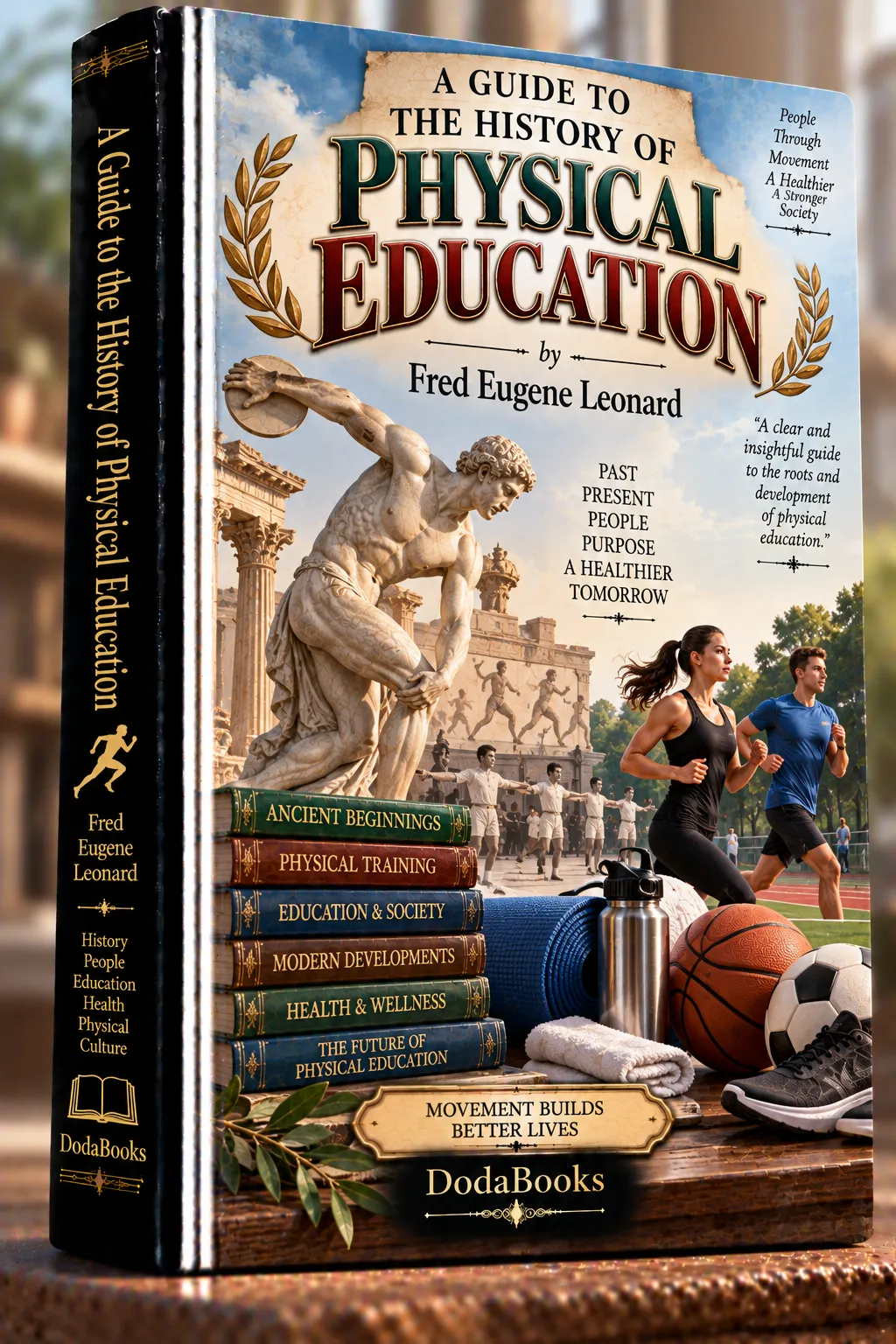
Explore the Complete History of Physical Training
Read Dr. Fred Eugene Leonard's masterwork in an annotated edition featuring historical notes on the ancient Olympics, Turners, Ling's gymnastics, and the evolution of modern sports medicine.
Get the History of Physical EducationThe Classical Foundations: Kalokagathia and Roman Militarism
Leonard begins his historical odyssey in ancient Greece, identifying the golden age of athletic philosophy. In classical Athens, physical education was never viewed as an isolated extracurricular hobby, but as an indispensable pillar of civic virtue, summarized by the ideal of kalokagathia—the harmonious balance of physical beauty and moral excellence.
Leonard contrasts this Athenian ideal with competing ancient systems:
- Spartan Austerity: Gymnastics subordinate entirely to military survival, state discipline, and physical endurance, creating invincible hoplite warriors at the cost of intellectual culture.
- Athenian Balance: The synthesis of music, mathematics, and gymnastics championed by Plato and Aristotle, where running, wrestling, discus throwing, and jumping were cultivated to harmonize the passions and discipline the will.
- Roman Utilitarianism: The decay of participatory amateur athletics into passive imperial spectating, where blood-soaked gladiatorial combat and chariot races entertained a sedentary urban mob—a decline that Leonard viewed as a sobering historical warning.
The Modern European Revival: Turners, Ling, and British Games
A massive portion of Leonard’s treatise is dedicated to the nineteenth-century European physical education renaissance, which provided the institutional models adopted across the globe:
1. Friedrich Ludwig Jahn and the German Turners
Leonard provides an authoritative analysis of “Turnvater” Friedrich Ludwig Jahn (1778–1852), who invented the horizontal bar, parallel bars, pommel horse, and rings. Following Prussia’s devastating defeat by Napoleon at Jena in 1806, Jahn established outdoor gymnastic grounds (Turnplatz) to forge a physically hardy, patriotic youth capable of liberating the fatherland. When 1848 revolutionaries brought the Turners to America, they became powerful cultural forces for abolitionism and public fitness.
2. Pehr Henrik Ling and Swedish Remedial Gymnastics
Leonard details the pioneering work of Pehr Henrik Ling (1776–1839) in Stockholm, who grounded physical education in anatomical and physiological science. Developing medical, educational, and military gymnastics without heavy apparatus, Ling created the world’s first systematic system of corrective kinesiology, posture alignment, and calisthenics.
3. The British Public School Athletic Cult
Leonard examines how Victorian England developed an alternative athletic tradition rooted in team sports—cricket, rugby, rowing, and football. At schools like Rugby and Eton, headmasters like Thomas Arnold championed “Muscular Christianity,” arguing that team games cultivated character, leadership, fair play, and emotional stoicism far more effectively than German apparatus drills.
Comprehensive Historical Scope
The definitive scholarly chronicle covering 2,500 years of athletic history, from Spartan military agoge to 20th-century collegiate athletic programs.
Medical & Physiological Rigor
Written by a medical doctor and hygiene professor, integrating anatomical science, respiratory physiology, and kinesiology into historical analysis.
Primary Source Documentation
Extracts from original German, Swedish, French, and English gym manuals, curricula, and royal decrees rarely assembled in a single volume.
Modern Pedagogical Annotations
Footnotes connecting Leonard's 1923 text to modern sports science, kinesiology, Title IX, and the contemporary fitness movement.
Women’s Physical Education and the Sargent Anthropometric Legacy
A groundbreaking aspect of Leonard’s scholarship that remains deeply admired by modern sports historians is his comprehensive documentation of the emergence of physical education for women. During the Victorian era, medical orthodoxy often warned that vigorous athletic exertion would damage women’s reproductive health or cause permanent nervous exhaustion.
Leonard dismantled these misconceptions through historical and empirical documentation:
- Catharine Beecher’s Calisthenics: Leonard traces the pioneering work of Catharine Beecher in the 1830s and 1840s, who designed the first systematic American calisthenic routines specifically for young women in female seminaries, emphasizing posture, deep breathing, and graceful movement without heavy weights.
- The Boston Normal School of Gymnastics: Leonard documents the founding of the Boston Normal School of Gymnastics in 1889 by philanthropist Mary Hemenway and director Amy Morris Homans, which trained generations of female instructors in Swedish remedial gymnastics and scientific anthropometry.
- Dr. Dudley Allen Sargent and Anthropometric Measurements: At Harvard and the Sargent School for Physical Education, Dr. Dudley Sargent pioneered detailed anthropometric measurements of female students. Leonard presents the comparative data showing that systematic gymnastic training increased lung capacity, corrected scoliosis, and significantly improved overall health and academic stamina among college women.
The American Synthesis and the Battle of the Systems
When physical education took root in the United States in the late nineteenth century, it sparked what historians call the “Battle of the Systems.” School boards, military academies, and universities debated fiercely over which European method to adopt:
- Should American schools follow the rigid German apparatus gymnastic system of Jahn?
- Should they mandate the precise, apparatus-free Swedish calisthenics of Ling?
- Or should they embrace the spontaneous, competitive team games of the British tradition?
Leonard was not merely an observer of this debate; he was one of its leading moderators. At Oberlin College, where he directed the Men’s Gymnasium from 1892 until his death in 1922, Leonard advocated for a distinctively American synthesis: combining the scientific posture correction of the Swedish system, the muscular strength of German apparatus training, and the character-building teamwork of intercollegiate sports.
“Physical education is not the training of the bodily animal in isolation from the intellect; it is education by means of the physical—the training of the whole human organism toward social competence, moral self-control, and radiant health.”
Understand the Roots of Modern Fitness & Kinesiology
Read Dr. Fred Eugene Leonard's monumental treatise in an impeccably formatted digital edition with detailed bibliographies and historical commentary.
Get the Edition on DodaBooksThe Legacy of Dr. Fred Eugene Leonard
Dr. Leonard passed away in 1922, shortly before the final publication of his magnum opus, which was prepared for the press by his colleague and former student, Professor George B. Affleck. For over half a century, A Guide to the History of Physical Education served as the required standard textbook in physical education graduate programs across North America.
Today, as our society confronts an epidemic of sedentary lifestyle diseases, screen addiction, and debates over the role of physical fitness in public health, Dr. Leonard’s work is more vital than ever. He reminds us that physical culture is not a superficial vanity, but a profound cultural imperative tied directly to the vitality, longevity, and democratic health of a civilization.
Why Sports Scholars and Kinesiologists Rely on Leonard
Dr. Leonard's meticulous archival research, linguistic mastery of German and Swedish sources, and objective medical perspective ensure that this volume remains the definitive historical benchmark for anyone studying the human body in motion.
Annotations and Apparatus in the DodaBooks Edition
The DodaBooks curated edition provides:
- Biographical Register of Physical Culture Pioneers: Profiles of Jahn, Ling, Archibald Maclaren, Dudley Sargent, and Baron Pierre de Coubertin.
- Apparatus Diagrams and Terms: Explanations of historic gymnastics equipment, Swedish stall-bars, and calisthenic drill routines.
- Comparative Chronology: A timeline matching major pedagogical breakthroughs with political events, including the Napoleonic Wars and the revival of the modern Olympic Games in 1896.
Own the Definitive Digital Edition
Download A Guide to the History of Physical Education today and explore the monumental history of human athletic training and health.
Download the Edition NowFrequently Asked Questions
Who was Dr. Fred Eugene Leonard?
Dr. Fred Eugene Leonard (1866–1922) was an American physician, educator, and professor of hygiene and physical education at Oberlin College. He is recognized as the foundational historian of physical education in the United States.
What historical periods are covered in this guide?
The book traces the history of physical education from classical Greece and Rome through the Middle Ages, the Renaissance, the rise of German Turners and Swedish gymnastics in the 19th century, and the development of American school and college athletics up to the 1920s.
What was the 'Battle of the Systems' in American physical education?
The 'Battle of the Systems' was a fierce late-19th-century debate among American educators over whether to adopt German apparatus gymnastics (Jahn), Swedish corrective calisthenics (Ling), or British competitive team sports as the national model for school physical education.
How does this book benefit modern coaches and kinesiologists?
It provides an indispensable historical and philosophical foundation for understanding how modern exercise science, sports pedagogy, and physical therapy evolved, revealing the origins of modern training equipment, drills, and athletic concepts.
Where can I purchase the complete annotated ebook?
The complete, annotated digital edition of Leonard's classic is available for immediate download at DodaBooks at https://dodabooks.com/ebook/a-guide-to-the-history-of-physical-education-by-fred-eugene-leonard/.