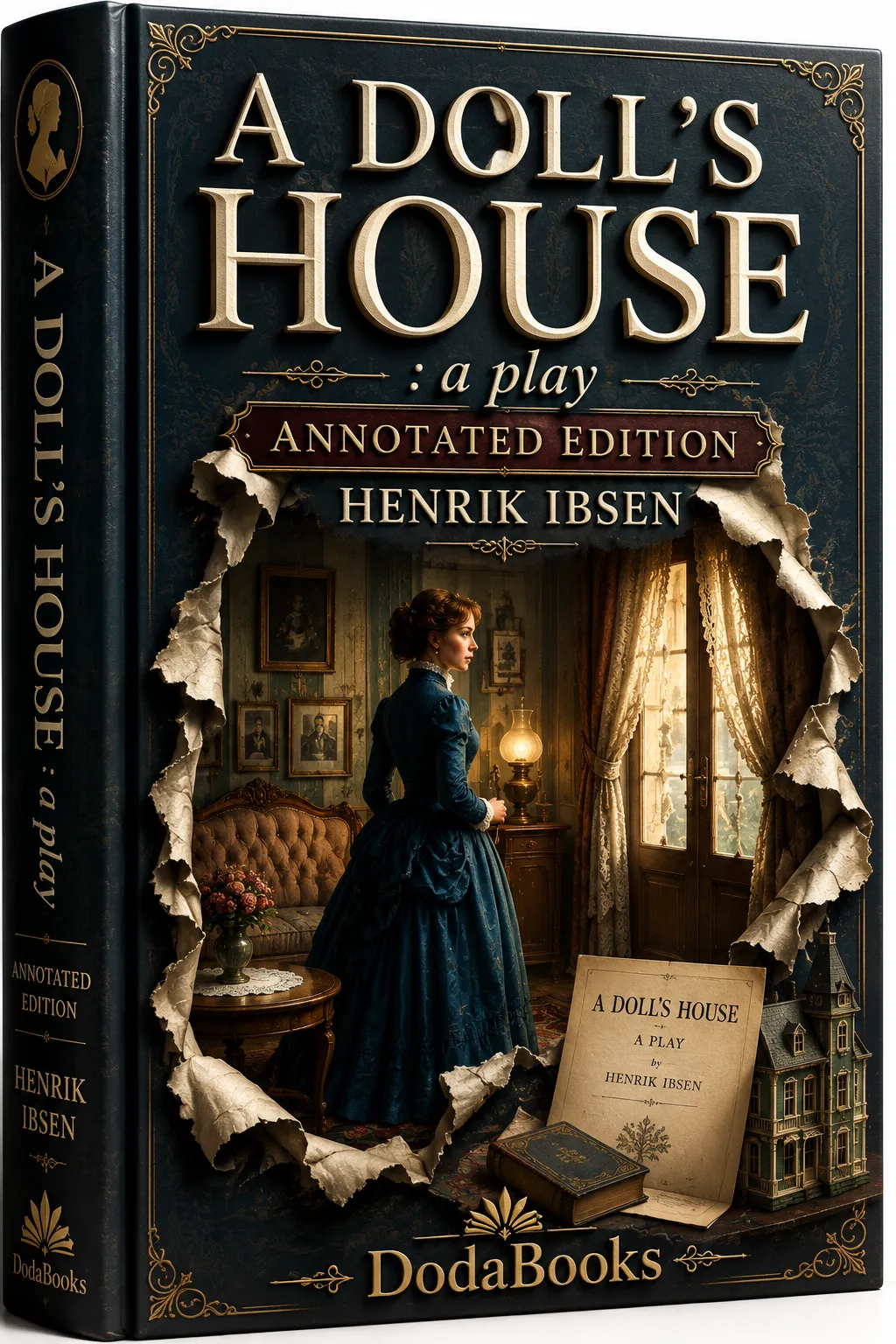
Henrik Ibsen’s A Doll’s House (Et dukkehjem, 1879) is the revolutionary drama that shattered the European theatre and launched modern realism. Culminating in the most famous slammed door in theatrical history, this searing dissection of middle-class marriage, financial desperation, and female autonomy provoked international outrage and forever changed the landscape of modern literature.
🚪
A Doll's House
The explosive masterpiece that heralded modern drama and female awakening. Unpack Henrik Ibsen's searing critique of Victorian bourgeois marriage, societal hypocrisy, and Nora Helmer's courageous quest for selfhood.
| Author | Henrik Ibsen |
| Premiere | December 21, 1879 (Royal Theatre, Copenhagen) |
| Genre | Realistic Drama, Problem Play, Modern Tragedy |
| Setting | Torvald Helmer’s comfortable middle-class apartment, Christiania (Oslo), Norway |
| Central Themes | The Illusion of Bourgeois Respectability, Female Self-Realization, The Tyranny of Social Codes, Money and Power |
| Reading Time | 2–3 hours |
| Summary Time | 18 minutes |
💥 The Door Slam Heard Around the World
When A Doll’s House premiered at the Royal Theatre in Copenhagen on December 21, 1879, it detonated an intellectual explosion across European society. The play was not merely a theatrical hit; it was a civilizational scandal. Across Scandinavian and British society, heated arguments over Nora’s actions broke out in drawing rooms and dinner parties with such ferocious intensity that wealthy hostesses began printing formal caveats on their invitations: “Guests are requested not to mention Ibsen’s A Doll’s House.”
Ibsen was inspired by the real, tragic ordeal of a young Norwegian woman named Laura Kieler, an author and personal friend. When her husband contracted tuberculosis, Laura secretly forged a promissory note to secure a loan to finance a life-saving trip to Italy. When the forgery was discovered, her husband brutally repudiated her, divorced her, had her committed to a public lunatic asylum, and stripped her of custody of their children.
Deeply outraged by society’s heartless treatment of women who sacrifice themselves for their families, Ibsen wrote in his preparatory notes for the play in Rome in October 1878:
"A woman cannot be herself in modern society. It is an exclusively male society,
with laws made by men and with prosecutors and judges who assess feminine conduct
from a masculine standpoint."
📜 Act-by-Act Dramatic Breakdown
The play unfolds over three tense days during Christmas week in the Helmer household:
Act I: The Domestic Cage and the Hidden Crime
The play opens on Christmas Eve in the warm, tastefully furnished living room of Torvald and Nora Helmer. Torvald has just been promoted to manager of the Joint Stock Bank, promising financial prosperity. Torvald treats Nora like an adorable, helpless pet, addressing her with patronizing diminutives: his “little skylark,” his “squirrel,” his “little spendthrift.” Nora appears to happily perform this submissive, childlike role, sneaking forbidden macaroons behind his back.
The illusion cracks with the arrival of two visitors:
- Mrs. Kristine Linde: Nora’s impoverished childhood friend, who arrives seeking employment. To Kristine, Nora confesses a monumental secret: years earlier, when Torvald was dying of overwork, Nora saved his life by taking him to Italy. Torvald believes the money came from Nora’s father; in reality, Nora secretly borrowed the money from a moneylender and has been secretly copying documents late at night to pay off the debt.
- Nils Krogstad: A disgraced bank clerk facing dismissal by Torvald. Krogstad reveals that he was Nora’s moneylender. Worse, to secure the loan, Nora forged her dying father’s signature on the bond. Krogstad blackmails Nora: unless she convinces Torvald to keep him at the bank, he will expose her forgery to Torvald and the public.
When Nora tries to plead for Krogstad, Torvald refuses with pompous moral disgust, declaring that a home contaminated by lies and forgery sickens the children.
Act II: The Desperate Dance
On Christmas Day, Nora’s panic intensifies. Torvald officially sends Krogstad his letter of dismissal. In retaliation, Krogstad drops a letter detailing Nora’s crime into Torvald’s locked mailbox in the hall. Nora can see the letter through the glass wire, but only Torvald has the key.
Desperate to delay Torvald from opening the mailbox, Nora rehearses the Tarantella—a frenzied southern Italian dance she is to perform at a neighbor’s costume party tomorrow. Nora dances with wild, uncontrolled desperation, her hair falling loose, as if dancing for her life. Torvald is astonished: “My dear darling Nora, you are dancing as if your life depended on it!” Nora whispers aside: “And so it does.” Nora privately believes that when Torvald discovers the truth, the “miracle of miracles” will happen: Torvald will step forward like a chivalric hero, take the entire blame upon himself, and sacrifice his reputation to protect his wife.
Act III: The Slammed Door
The night of the costume ball. While the Helmers are upstairs, Kristine Linde and Krogstad meet in the living room. It is revealed that they were once lovers. Kristine offers Krogstad her love and partnership, and a transformed Krogstad resolves to take back his blackmail letter. However, Kristine insists that the letter remain: the toxic lies in the Helmer household must be exposed to the light of truth.
Torvald brings Nora down from the party, flush with physical desire. After opening his mail, Torvald erupts in savage fury. He calls Nora a hypocrite, a liar, and a criminal, declaring that she has destroyed his life and honor. He proclaims that while they must maintain outward appearances for society, Nora is unfit to raise their children.
Suddenly, a second letter from Krogstad arrives: moved by his reunion with Kristine, Krogstad returns the forged bond, forgiving the debt. Instantly, Torvald’s demeanor reverses. Relieved that his own reputation is safe, he smiles, laughs, and forgives Nora: “I am saved! Nora, I am saved!… I have forgiven you everything; I know that what you did was done out of love for me.”
Nora looks at her husband with cold, devastating clarity. She realizes that Torvald never loved her; he only enjoyed being in love with her, treating her as a decorative possession. Nora changes out of her fancy costume into her everyday street dress and sits down at the table for their first serious conversation in eight years of marriage.
Nora announces that she is leaving Torvald and her children immediately. Torvald gasps in horror, reminding her of her sacred duties as a wife and mother. Nora delivers her immortal reply: “I believe that before all else I am a reasonable human being, just as you are—or at all events, that I must try and become one.” Handing back her wedding ring, Nora walks out into the winter night, and the play ends with the heavy, resounding slam of the front door.
👥 Character Profiles & Theatrical Dynamics
🚪 NORA HELMER
The Doll Who Awakens
“Our home has been nothing but a playroom. I have been your doll-wife, just as at home I was papa’s doll-child.”
Nora begins as a playful, coquettish bourgeois wife who performs childlike submission to stroke her husband’s male ego. When crisis hits, she reveals steel resolve, moral maturity, and revolutionary courage.
Why She Matters
Nora is the iconic symbol of female emancipation in world literature. Her refusal to sacrifice her identity for bourgeois respectability fundamentally transformed modern drama.
🎩 TORVALD HELMER
The Slave of Respectability
“No man would sacrifice his honour for the one he loves.” (To which Nora famously replies: “Thousands of women have done so.”)
Torvald is not an evil villain, but a pompous, conventional product of Victorian patriarchy. He values public reputation and social conformity above love, truth, or human connection.
Why He Matters
Torvald represents the moral bankruptcy of bourgeois institutions, revealing how systemic male dominance dehumanizes both men and women.
✉️ NILS KROGSTAD
The Desperate Outsider
“I will tell you. I want to rehabilitate myself, Mrs. Helmer; I want to get on; and in that your husband must help me.”
Krogstad is an outcast lawyer pushed into ruthless blackmail by social ostracization. Reunited with Kristine Linde, he reveals a tender capacity for redemption.
Why He Matters
Ibsen avoids melodrama by making his “antagonist” a fully human victim of social stigma, demonstrating how social unforgiveness breeds crime.
📘 Annotated Insight — When A Doll’s House was produced in Germany in 1880, famous actress Hedwig Niemann-Raabe refused to perform the ending, declaring: “I would never leave my children!” To prevent unauthorized rewrites, Ibsen reluctantly penned a humiliating alternative “German ending” where Nora collapses at the nursery door. Ibsen later fiercely repudiated this revision, calling it an “act of barbaric violence against the play.”
🔍 Major Themes & Critical Significance
1. The Doll’s House as Metaphor for Patriarchal Control
Nora realizes that her entire existence has been an unbroken sequence of patronizing doll-play: passed from her father’s authority directly into her husband’s custody without ever discovering who she is. Her marriage was not a true partnership, but an aesthetic performance where her function was to flatter Torvald’s vanity.
2. Legal Law vs. Moral Conscience
The central legal conflict of the play pits institutional, male-written law against human necessity. By the laws of 19th-century Norway, a married woman had no legal financial rights and could not borrow money without her husband’s or father’s co-signature. Nora asks the fundamental moral question: “A woman has no right to spare her dying old father, or to save her husband’s life? I don’t know much about the law, but I’m certain there must be something in it that allows that.”
3. The Miracle of Miracles
Throughout Act II, Nora clings to the illusion that Torvald is a noble knight who will take her guilt upon himself. The catastrophe of Act III is not that her forgery is exposed, but that Torvald’s cowardice is exposed. The failure of the “miracle” shatters Nora’s illusions and forces her into independence.
📖 Explore the Annotated Edition at DodaBooks →
✨ What Makes the DodaBooks Annotated Edition Essential
Reading Ibsen without historical and theatrical notes leaves modern readers disconnected from the explosive social stakes of 1870s Norway.
The DodaBooks Annotated Edition provides the ultimate critical reading experience:
19th-Century Marriage Laws
Detailed notes explaining the legal codes of 1870s Scandinavia regarding married women's property and promissory forgery.
The Laura Kieler Case Dossier
Read the real-life historical tragedy of Laura Kieler that inspired Ibsen to write the play in Rome.
The Censored German Ending
Includes the full text and historical background of the controversial alternative ending Ibsen was forced to write in 1880.
Tarantella Symbolism Unpacked
In-depth analysis of the Italian spider dance symbolism, Nora's psychological state, and stage choreography.
100% DRM-Free Freedom
Enjoy permanent digital ownership across all your favorite devices: Kindle, Kobo, Apple Books, and Android.
Professional Script Layout
Beautiful theatrical typography with clear speaker headings, responsive stage directions, and smart punctuation.
❓ Frequently Asked Questions
Why does Nora leave her children at the end of the play?
Nora's decision to leave her children was the most controversial aspect of the play in 1879. Nora realizes that because she has lived only as a submissive "doll," she is currently unfit to educate her children into healthy, independent adults. She must first discover her own humanity and moral values before she can be a true mother.
What does the Tarantella dance symbolize?
The Tarantella was a southern Italian folk dance traditionally believed to cure the venomous bite of the tarantula spider. In the play, Nora dances with wild, frantic abandon to delay Torvald from opening the letter, symbolizing her desperate attempt to purge the poison of bourgeois deceit from her life.
Did Ibsen consider himself a feminist?
In a famous speech to the Norwegian Association for Women's Rights in 1898, Ibsen stated: "I thank you for the toast, but must disclaim the honor of having consciously worked for the women's rights movement... To me it has appeared as the problem of human beings in general." While Ibsen viewed his play as a universal drama of human liberation, its critique of patriarchal marriage remains a cornerstone of feminist literature.
What is the "miracle of miracles" Nora speaks of?
The "miracle of miracles" refers to Nora's secret hope that Torvald would step forward, take the blame for her forgery upon himself, and sacrifice his reputation for her. When Torvald instead curses her and cowers for his own social standing, the illusion is destroyed.
Why should I purchase the DodaBooks edition?
Many free online copies of A Doll's House use obsolete Victorian translations that soften Ibsen's sharp, realistic dialogue. DodaBooks provides the definitive, unabridged text with comprehensive annotations on Victorian legal codes, the real Laura Kieler scandal, and the infamous alternative ending.
🚪 Hear the Door Slam that Changed World Theatre
Witness Nora Helmer’s revolutionary awakening in Henrik Ibsen’s masterpiece. The DodaBooks Annotated Edition of A Doll’s House delivers:
- ✅ Complete Unabridged 3-Act Drama — Plus the full historical German alternative ending
- 📜 Legal & Theatrical Footnotes — Deep context on 19th-century marriage laws and realism
- ✒️ Typeset for Theatrical Reading — Clear character labels, stage directions, and clean formatting
- 🔒 100% DRM-Free Ownership — Yours forever across Kindle, Kobo, and iPad
- 📥 Instant Download — Immediate delivery in pristine EPUB format
For another thrilling story of female rebellion against patriarchal control in Edwardian England, explore H.G. Wells’ scandalous classic in our Ann Veronica Guide.