A Connecticut Yankee in King Arthur's Court Summary by Chapter: Complete Plot Breakdown
When Mark Twain published A Connecticut Yankee in King Arthur’s Court in 1889, he created one of the most daring, imaginative, and tonally complex narratives in American literature. The novel is not merely a hilarious burlesque of medieval chivalry and Arthurian romance; it is an epic forty-four-chapter philosophical thought experiment exploring the collision between democratic capitalism and feudal superstition.
Through the sharp, practical voice of Hank Morgan, a 19th-century arms-factory superintendent from Hartford, Connecticut, readers are plunged across thirteen centuries into early medieval Britain. Hank begins with noble ambitions to abolish slavery, dismantle the divine right of kings, and establish a modern constitutional republic. Yet his relentless reliance on mechanical power and high-explosive weaponry culminates in an unforgettable apocalyptic nightmare.
This comprehensive chapter-by-chapter summary provides an exhaustive breakdown of every major plot movement, satirical confrontation, and thematic turning point across the entire novel.
| Section | Chapters | Major Plot Movements | Core Thematic Focus |
|---|---|---|---|
| Prologue & Arrival | Frame & Ch. 1–4 | The narrator meets Hank at Warwick Castle; the Colt factory brawl; capture by Sir Kay; Camelot Great Hall | The Clash of Realities; Satire of Malory; Medieval Hygiene & Manners |
| Ascension of ‘The Boss’ | Ch. 5–10 | Hank exploits the June 21, 528 AD solar eclipse; destruction of Merlin’s tower; creation of secret factories | Knowledge as Power; Scientific Method vs. Feudal Superstition |
| Knight-Errantry & Quest | Ch. 11–20 | Hank armors up; quest with Sandy; the “enchanted” pigsty castle; repairing the Holy Fountain in the Valley of Holiness | Burlesque of Chivalric Romance; Medieval Indoctrination; Religious Frauds |
| Disguised with Arthur | Ch. 21–33 | King Arthur travels as a commoner; the smallpox hut; peasant taxation; Dowley’s wage debate; capture by slave-traders | The Brutality of Feudal Law; Economics of Wages; Arthur’s Kingly Nobility |
| Slavery & The Duel | Ch. 34–39 | The London slave-march; gallows rescue on bicycles; duel with Sir Sagramor; lasso and revolvers annihilate chivalry | Triumph of Technology; Abolition of Knighthood; The Fragile Golden Age |
| The Catastrophe | Ch. 40–44 | The Papal Interdict; Arthur’s death; electric fences and Gatling guns at the Sand-Belt; Merlin’s curse | The Horror of Mechanized War; The Retrenchment of Church Superstition |
🏰 Prologue & Arrival: The 19th Century Meets Camelot
A Word of Explanation (The Framing Story)
While touring the historic armory of Warwick Castle in England, the unnamed narrator encounters an eccentric, soft-spoken stranger. The stranger points out a curious circular hole in a 6th-century breastplate attributed to Sir Sagramor le Desirous, quietly remarking that it was made not by an arrow or crossbow bolt, but by a modern bullet from a Colt .45 revolver. Later that night at an inn in Warwick, the stranger shares his astonishing story over tobacco and Scotch whiskey. He reveals that his name is Hank Morgan, born in Hartford, Connecticut, where he worked as head superintendent of the great Colt firearms factory. During a violent altercation with an insubordinate employee named “Hercules,” Hank was struck on the head with a crowbar and knocked unconscious.
When Hank fell asleep, he left behind a voluminous antique palimpsest—an ancient manuscript in his own handwriting. The remainder of the novel comprises this journal.
Chapter 1: Camelot
Hank awakens lying on fresh green grass under an oak tree. He is immediately accosted by an absurd figure: a man clad head-to-toe in medieval iron plate armor, riding a horse festooned with silk trappings. The knight announces that he is Sir Kay the Seneschal, foster brother to King Arthur, and claims Hank as his prisoner of war. Convinced he is the victim of a practical joke or an escapee from a local lunatic asylum, Hank agrees to accompany him. After climbing a hill, Hank gazes down upon a distant stone fortress: Camelot.
Chapter 2: King Arthur’s Court
Hank observes the filthy, impoverished peasantry lounging in dirt streets alongside pigs and scabby dogs. He is guided into Arthur’s Great Hall, where dogs fight savagely for bones under banquet tables while the Knights of the Round Table sit drunkenly around the massive circular oak board. Hank strikes up a conversation with a mischievous, twelve-year-old page named Amyas le Poulet, whom Hank nicknames Clarence. When Hank asks the date, Clarence blithely informs him that it is June 19 in the year 528 AD. Realizing he has been hurled backward across thirteen centuries, Hank’s practical American business acumen immediately ignites: if he is the only educated, scientifically trained mind in the entire British Isles, he possesses the ultimate monopoly.
Chapter 3: Knights of the Table Round
Hank sits through hours of insufferable boastfulness as knights recite absurd, exaggerated tales of their military prowess. Twain introduces extended, word-for-word excerpts from Sir Thomas Malory’s Le Morte d’Arthur, highlighting the childish credulity and bloodthirsty monotony of the chivalric code. Hank notes with disgust the total absence of sanitation, personal modesty, and intellectual curiosity among the highest nobility of England.
Chapter 4: Sir Dinadan the Humorist
Sir Dinadan, the court comedian, entertains the court with archaic, musty jokes that Hank recognizes as ancient chestnuts from his own 19th-century childhood. As the drunken knights fall asleep, Sir Kay steps forward to exhibit Hank, spinning a ludicrous lie about capturing Hank after a titanic struggle against an army of enchanted monsters in an enchanted land. Stirred to fury, King Arthur orders that the foreign barbarian be stripped, thrown into the dungeon, and burned at the stake at noon on the second day following.
⚡ The Eclipse & The Ascension of ‘The Boss’
Chapter 5: An Inspiration
Locked in a dark, dank dungeon beneath Camelot, Hank is visited by Clarence, who tearfully informs him that his execution has been moved up to noon the following day. Desperate to escape the flames, Hank searches his memory for historical facts. He suddenly recalls that a total solar eclipse occurred on June 21, 528 AD, beginning at precisely 12:03 PM! Hank instructs Clarence to deliver an ultimatum to the King: if they dare lay a hand on him, he will blot out the sun and plunge Britain into eternal darkness.
Chapter 6: The Eclipse
At midday on June 21, Hank is bound to a wooden stake in the courtyard of Camelot. Bundles of dry brushwood are piled around his feet, and an executioner steps forward with a burning brand. Just as the fire touches the wood, the black rim of the moon begins to creep across the sun. The sky turns an eerie, unnatural purple; the temperature drops; birds cease singing; and total darkness blankets the earth.
Panicking in hysterical terror, the entire assembly collapses to their knees. King Arthur frantically begs Hank to banish the dark curse. Hank bargains with cool, ruthless audacity: he agrees to restore the sun only on the condition that he be appointed the King’s perpetual Prime Minister and chief executive officer, receiving a salary of one percent of all new wealth he creates for the kingdom. The King eagerly agrees. At the exact moment of totality’s conclusion, Hank stretches forth his arm, commands the light to return, and the sun bursts forth. Hank is saved.
Chapter 7: Merlin’s Tower
Hank is installed in luxurious quarters in the palace. However, Merlin the Magician, humiliated and displaced from his position as chief royal counselor, begins spreading rumors that Hank’s magic was a minor, temporary illusion. To crush Merlin’s reputation permanently, Hank accepts a challenge to perform an even greater miracle.
Hank orders Clarence to manufacture a batch of crude blasting powder and potassium chlorate. Under the cover of darkness, Hank hollows out the foundation of Merlin’s stone tower on a nearby hill, packs it with gunpowder, and runs an insulated copper wire to a hidden galvanic battery. In front of a vast throng of spectators, as Merlin performs useless theatrical chanting, Hank presses the circuit switch. With an ear-splitting roar, Merlin’s tower explodes into a fountain of pulverized stone and fire. Merlin’s credibility is utterly destroyed.
Chapter 8: The Boss
Recognizing Hank’s unquestioned authority, the common people bestow upon him the reverent title “The Boss.” Hank immediately begins his quiet, comprehensive modernization of early medieval England. Knowing that the superstitious nobility and the powerful Roman Catholic Church would violently suppress any open attempt at social reform, Hank operates entirely in secret.
Chapters 9–10: The Secret Civilization & The Man-Factories
Hank establishes concealed underground schools, machine shops, foundries, and chemical laboratories. In these “Man-Factories,” he hand-selects promising peasant youths and trains them in literacy, mechanics, mathematics, electricity, and democratic philosophy. Meanwhile, to acclimate the public to modern commerce, Hank introduces the concept of commercial advertising. He equips wandering knights with painted sandwich boards, sending them across the wilderness advertising tooth-wash, stove polish, and Persimmon’s Soap.
Unpack the full historical context and Gilded Age satire of Twain's masterpiece.
📖 Get the Annotated Edition at DodaBooks →🛡️ The Knightly Quest & The Valley of Holiness
Chapters 11–14: Armored Discomfort & The Maiden Sandy
Sir Sagramor le Desirous, taking offense at a misunderstanding, challenges Hank to a duel to the death. Because Sagramor departs on a quest to find the Holy Grail, the duel is postponed for several years. To satisfy court etiquette, Hank is required to embark on a knight-errant quest of his own. A garrulous young noblewoman named Alisande la Carteloise (Sandy) arrives at court, babbling hysterically about forty-five noble princesses held captive by three ferocious ogres in a terrible castle.
Hank is forced into a full suit of polished plate armor. Chapters 11 and 12 feature some of Twain’s finest physical comedy, as Hank suffers excruciating torments inside his metal shell: he cannot scratch his nose, his metal shoes roast his feet in the summer heat, and when sweat pours into his eyes, he must stop and beg Sandy to pour buckets of water through his helmet visor.
Chapters 15–19: The Holy Fountain & The Rival Magician
En route to Sandy’s castle, they detour to the renowned Valley of Holiness, a famous monastic retreat where a miraculous holy fountain has suddenly run dry. The resident monks believe that the fountain dried up because a young novice committed a minor religious sin, and Merlin has spent several fruitless days burning incense and chanting incantations to appease the spirits.
Hank inspects the well and immediately recognizes the problem: a simple fracture in the subterranean masonry wall has allowed the water to drain into an underground gravel bed. Hank sends Clarence an urgent telegraph dispatch requesting hydraulic cement, iron piping, two pumping engines, and a crate of colored Greek fire and flares. After secretly patching the cistern at night, Hank stages a stupendous public “miracle.” Clad in theatrical robes, Hank produces bursts of green, red, and purple chemical fire, shouts nonsense pseudo-German phrases, and starts the hidden pumps. Water gushes forth in roaring torrents, and the monks fall down worshiping Hank.
The following morning, an itinerant rival magician arrives, boasting that he can look into the spirit realm and tell precisely what any monarch on earth is doing at that exact moment. Hank challenges him: “What is King Arthur doing right now?” The magician declares that the King is asleep in his bed at Camelot. Hank taps his concealed telegraph line to Clarence and reveals the truth: King Arthur is not asleep; he is traveling on horseback and will arrive in the Valley of Holiness within two hours! When Arthur appears right on schedule, the humiliated charlatan is laughed out of the valley.
Chapter 20: The Ogre’s Castle
Hank and Sandy finally reach the dreaded fortress of the three giant ogres. To Hank’s utter astonishment, the “castle” is nothing more than a squalid wooden hog pen, and the “forty-five captive princesses” are an ordinary herd of muddy swine.
Yet Sandy is so deeply conditioned by chivalric romance that she genuinely sees the hogs as beautiful aristocratic ladies enchanted by wicked enchanters. Recognizing that human delusion cannot be cured by logical argument, Hank indulges her fantasy, pays the swineherds twenty-four pennies to buy the hogs, and treats the grunting animals with ceremonial courtly deference.
👑 Disguised with the King: The Horror of Feudal Oppression
Chapters 21–28: Travel in Disguise & The Peasant Sufferings
Returning to Camelot, Hank convinces King Arthur to disguise himself as a common peasant so that the monarch can witness firsthand the actual economic and social conditions under which his subjects live.
As they travel the countryside on foot, Hank finds King Arthur’s aristocratic conditioning a source of constant frustration. Despite wearing rough homespun clothing, Arthur walks with an arrogant, chin-in-the-air swagger that immediately identifies him as an aristocrat. Hank is forced to drill the King endlessly in the art of the humble, stooping peasant slouch.
The narrative darkens profoundly as Hank and Arthur witness the routine, legalized atrocities of the feudal system:
- The Burning of the Lord’s Manor: A young peasant woman whose husband was hanged for hunting a deer reveals that her lord took their meager grain supply, leaving her babies to starve.
- The Smallpox Hut: Hank enters an abandoned, decaying cottage and finds a family dying of smallpox. A dying mother clutches her dead child, praising God for the pestilence because it delivers her family from the endless cruelty of the local bishop and feudal baron. Arthur demonstrates genuine courage, gently lifting a dying young girl from a ladder to comfort her in her final moments.
Chapters 29–33: Dowley’s Fall & The Man-Hunt
In a prosperous village, Hank and Arthur are invited to dinner at the home of Marco the charcoal-burner, where they meet Dowley the blacksmith, a proud, self-satisfied craftsman. Hank engages Dowley in a famous debate on political economy and wages. Dowley boasts that workers in his region receive twice the daily wage of workers in the northern realm. Hank systematically dismantles Dowley’s pride by proving the difference between nominal wages and real purchasing power: although the northern workers earn fewer coins, basic commodities in the north cost a fraction of what they cost in the south, leaving northern workers far more prosperous.
When the debate grows heated, Hank inadvertently lets slip phrases and ideas that expose his contempt for the nobility. Terrified that they are harboring radical heretics, the villagers turn on Hank and Arthur with clubs and pitchforks. A violent mob chases them through the woods, cornering the King and Hank in an abandoned stone hut until they are rescued by a passing troop of horsemen.
⛓️ Slavery, The Gallows, & The Bicycle Cavalry
Chapters 34–37: Chained and Sold in London
Their rescue proves short-lived. The knight who saved them from the mob is an impoverished nobleman who promptly betrays them. He drugs Hank and Arthur, strips them of their belongings, and sells them to an itinerant slave-trader.
Twain uses this sequence to deliver an uncompromising critique of human bondage, deliberately evoking the atrocities of the American antebellum slave trade. Chained neck-to-neck with other miserable captives, Hank and Arthur are marched hundreds of miles through freezing blizzards toward London. Arthur is whipped across the shoulders when he refuses to march, experiencing the humiliation and agony of chattel property.
In London, Hank manages to pick his lock using a scavenged piece of wire. He slips away into the night, locates a telegraph office, and sends an urgent distress signal to Clarence in Camelot. However, when Hank returns to the slave quarters to liberate Arthur, a fight breaks out, the slave-dealer is killed, and the entire troupe of slaves is captured by the City Guard. Because they cannot prove their identities, Arthur and the slaves are sentenced to be hanged on the public gallows the following morning.
Chapters 38: The Bicycle Cavalry!
The execution morning arrives in London. Several slaves have already been hanged, and the noose is placed around King Arthur’s neck. As the executioner prepares to pull the trapdoor, Hank looks desperately toward the horizon.
Suddenly, a breathtaking spectacle bursts into view: five hundred of Hank’s hand-trained knights come roaring down the hill, clad in plate armor, riding safety bicycles, with Clarence at their head! The knights draw repeating revolvers, fire a deafening volley into the air, scatter the terrified executioners, and rescue the King in one of the most uproarious climaxes in comic literature.
⚔️ The Chivalric Duel & The Modern Republic
Chapter 39: The Duel with Sir Sagramor
Having returned to Camelot in triumph, the long-delayed duel between Hank and Sir Sagramor le Desirous takes place before a crowd of thousands. Merlin equips Sagramor with an “invisible magic veil” that he guarantees will ward off any physical blow.
Sagramor enters the arena mounted on a gigantic armored warhorse, leveling a heavy twelve-foot steel-tipped lance. Hank enters the lists riding a light, nimble pony, wearing no armor whatsoever—just white linen shirt, trousers, and leather boots. As Sagramor charges at full gallop, Hank deftly sidesteps his horse, twirls a cowboy lasso, loops it over Sagramor’s head, and jerks the armored knight violently out of the saddle into the dirt.
Enraged by this humiliation, Sir Sagramor demands a second round on foot with broadswords. Hank draws a pair of Colt .45 revolvers. When Sagramor charges with his sword raised, Hank fires a single shot, dropping him dead. Hank then boldly challenges the entire assembly of English chivalry:
“I stood in the center of that vast amphitheater alone, with my pair of revolvers, and dared the chivalry of England to charge me!”
A squadron of five hundred knights charges Hank en masse. Standing his ground, Hank shoots dead eleven knights in succession. Terrified by this thunderous, invisible weapon, the remaining hundreds of knights turn and flee in panic. Knighthood is abolished; feudal chivalry is officially dead.
Chapter 40: Three Years of The Republic
For three glorious years, Hank’s dream of an enlightened England becomes reality. Slavery is eradicated; universal public education is established; a national currency and postal system flourish; newspapers circulate freely; and the country is laced with railroads, telegraphs, and electrical lighting. King Arthur rules as a constitutional figurehead, and Hank is happily married to Sandy, who gives birth to a beloved daughter whom they name Hello-Central (after Hank’s favorite 19th-century telephone greeting).
⚡ The Apocalypse: The Interdict & The Sand-Belt
Chapter 41: The Papal Interdict
When baby Hello-Central contracts a severe illness, doctors recommend a sea voyage to the warm climate of France. Hank and Sandy depart for two months.
While Hank is abroad, disaster strikes. Queen Guenever’s long-standing adultery with Sir Lancelot is exposed by Sir Mordred, shattering the Round Table. Arthur and Mordred wage a brutal civil war in which both are slain. Taking advantage of the chaos, the Roman Catholic Church strikes back with absolute fury. The Vatican issues a Papal Interdict.
When Hank sails back into Dover, he finds the country paralyzed: church bells are silenced, factories are abandoned, schools are shuttered, and the common people have retreated in terror into dark medieval superstition. The Church has mobilized the entire remaining nobility—twenty-five to thirty thousand armored knights—to march on Hank and exterminate the “demonic” technologies of modern civilization.
Chapters 42–43: The Battle of the Sand-Belt
Hank retreats with Clarence and fifty-two faithful teenage boys—young men educated from childhood in Hank’s Man-Factories who have not been contaminated by Church superstition—into the hidden cave system of Merlin’s Cave in the Sand-Belt.
Hank transforms the Sand-Belt into an impregnable modern killing field:
- Four concentric rings of barbed wire charged with high-voltage dynamos.
- An extensive grid of subterranean dynamite torpedoes and landmines wired to electric detonators.
- Twelve revolving Gatling machine guns mounted on parapets commanding the killing zones.
- An emergency sluice gate holding back a massive mountain river.
On a moonless night, thirty thousand knights advance in heavy battle formation. The battle begins with horrifying slaughter:
- When the forward scout units touch the outer wire fence, eleven thousand volts of electricity course through their iron armor, electrocuting hundreds instantly.
- Hank detonates the buried landmines, obliterating entire regiments in colossal fountains of fire and earth.
- As the remaining knights charge blindly into the depression, Hank unleashes the Gatling guns, mowing down thousands with ten thousand bullets per minute.
- Finally, Hank opens the floodgates, drowning thousands more in the swirling current.
Twenty-five thousand knights are slaughtered in a single night. Hank has won total military victory.
Chapter 44: The Sleeper Awakes
Yet Hank’s technological triumph becomes his absolute defeat. The twenty-five thousand rotting corpses in the summer heat create a poisonous zone of toxic contagion. Trapped inside their cave behind a wall of decomposing dead, Hank and his boys begin falling ill from the foul air.
Merlin, disguised as an impoverished peasant woman, sneaks into the cave under the guise of nursing the wounded. While Hank sleeps, Merlin casts a potent sleeping spell over him, cackling wildly that Hank will sleep for thirteen centuries until the modern world catches up with him. Merlin dances in hysterical triumph—until he accidentally brushes against an electrified wire and is electrocuted to death by his own enemy’s trap!
Final P.S. by M.T.
The narrative returns to the Warwick inn in the 19th century. The narrator enters Hank Morgan’s room and finds him tossing in delirious fever on his deathbed. In his dying moments, Hank speaks not to the modern world, but cries out for Sandy and his lost baby Hello-Central, mourning the golden medieval life that is gone forever:
“A bugle?… It is the King! The banners! The lances! Oh, Sandy, I have had a dream—a strange and terrible dream… The illusions are gone, Sandy… I am dying.”
Hank Morgan closes his eyes and passes away, stranded between two worlds.
❓ Frequently Asked Questions
How did Hank Morgan travel back in time to King Arthur's Court?
Hank was struck violently on the head with a crowbar during a factory brawl at the Colt firearms factory in Hartford, Connecticut. Unlike modern science fiction stories that use mechanical time machines, Twain utilized a traumatic head injury as a narrative device to facilitate Hank's temporal displacement to 528 AD.
Why does Hank Morgan call himself "The Boss"?
Hank rejects hereditary aristocratic titles like Duke or Earl because they represent unearned privilege. He chooses "The Boss" because it reflects American industrial meritocracy, authority earned through knowledge and competence, and his status as the chief executive of England's modernization.
What is the symbolic meaning of Sandy and the herd of pigs?
In Chapter 20, Sandy genuinely believes that a herd of dirty swine are forty-five enchanted princesses held captive by ogres. Twain uses this episode to illustrate his core thesis that "training is everything": Sandy is so thoroughly indoctrinated by chivalric romance that her perception of physical reality is completely warped.
Why did the Roman Catholic Church turn against Hank Morgan?
The medieval Catholic Church recognized that Hank's universal public schools, scientific education, printing presses, and democratic principles directly threatened their ecclesiastical monopoly on truth, authority, and taxation. The Church issued the Papal Interdict to restore medieval superstition and protect its power.
What does the Battle of the Sand-Belt say about Mark Twain's view of human progress?
The horrific slaughter at the Sand-Belt reveals Twain's profound skepticism toward the Gilded Age belief in inevitable human progress. By showing modern technology turning into an instrument of apocalyptic mass murder, Twain warned that scientific genius without ethical and spiritual maturity leads to self-destruction.
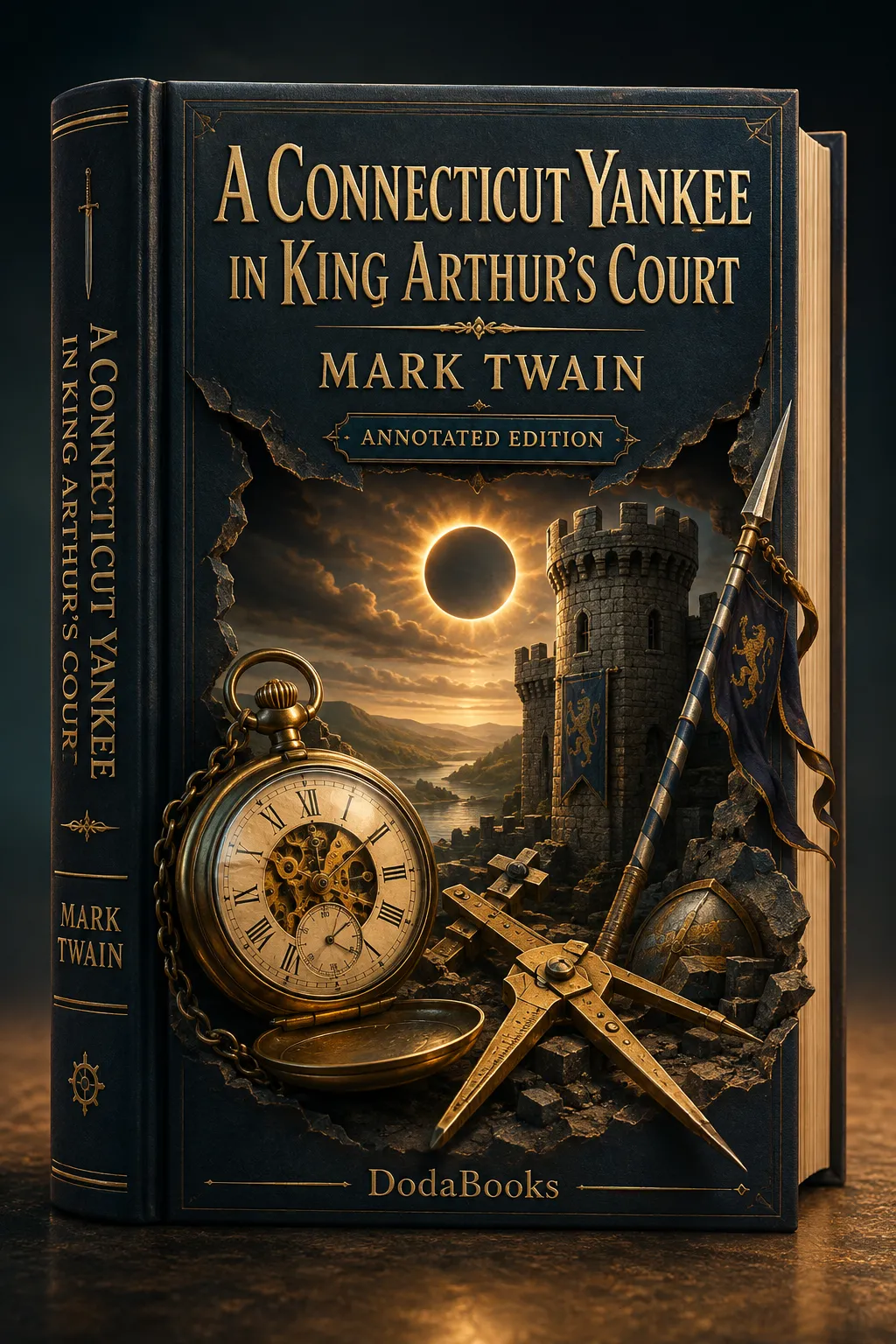
⚡ Read Mark Twain’s Complete Arthurian Time-Travel Epic
Experience every chapter of Hank Morgan’s unforgettable crusade against the Dark Ages. The DodaBooks Annotated Edition of A Connecticut Yankee in King Arthur’s Court delivers:
- ✅ Complete Unabridged 44 Chapters — Authoritative text including framing prologue and epilogue
- 📜 Historical & Mythological Annotations — Detailed explanations of Malory’s Morte d’Arthur, Gilded Age politics, and 6th-century Britain
- ✒️ Smart Reading Layout — Beautiful typography, clean chapter headings, and clear formatting
- 🔒 100% DRM-Free Ownership — Yours forever across Kindle, Kobo, iPad, and e-readers
- 📥 Instant EPUB Delivery — Download your digital copy immediately