Mark Twain’s A Connecticut Yankee in King Arthur’s Court (1889) is literature’s foundational time-travel satire, hurling a practical 19th-century American arms-factory superintendent into the superstitious feudal world of 6th-century Camelot. By pitting modern industrial technology, democratic republicanism, and Yankee horse sense against the tyrannical chivalry of the Round Table and an oppressive medieval Church, Twain crafted a work of comedic brilliance that darkens into a terrifying prophecy of modern mechanized warfare.
⚡
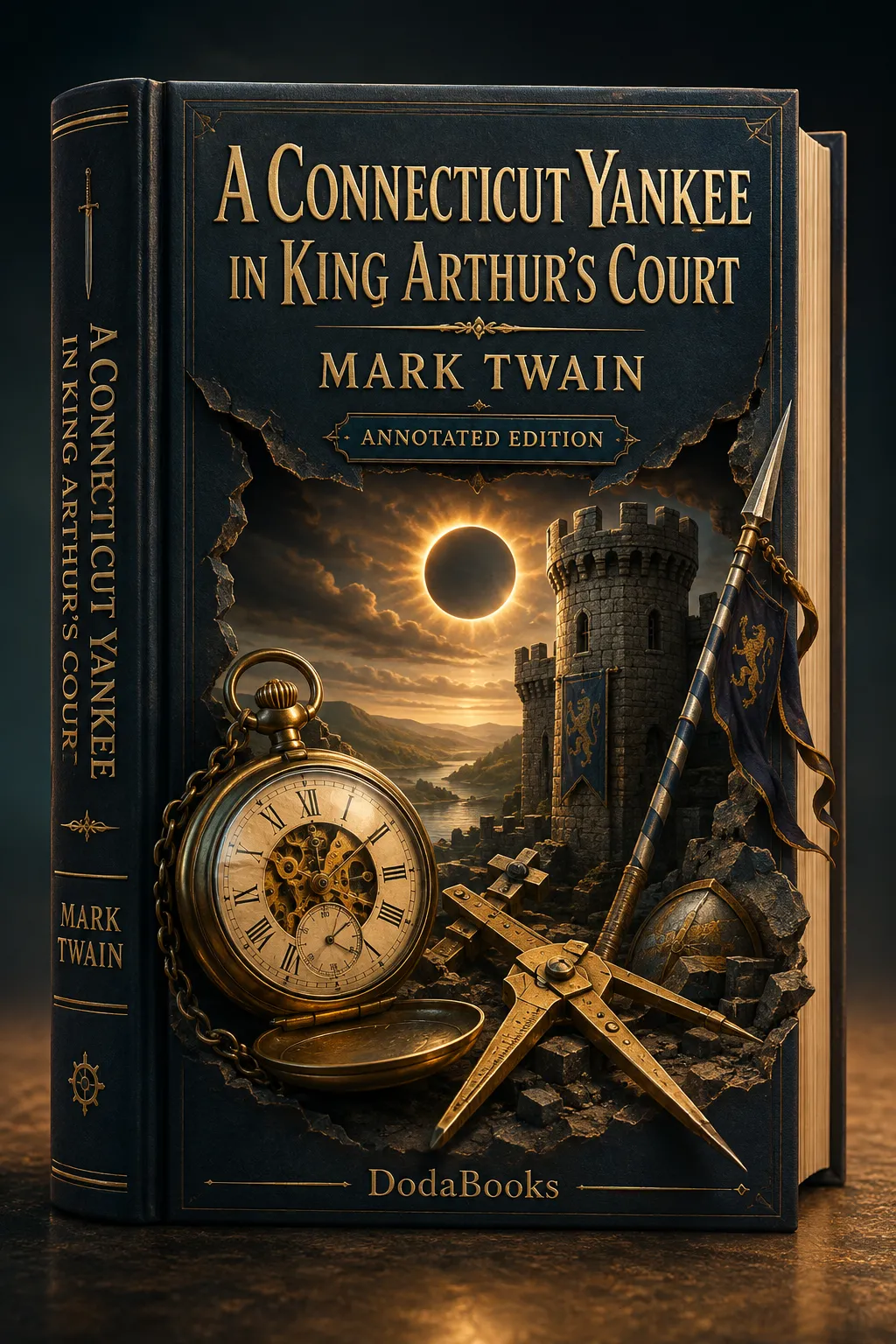
A Connecticut Yankee in King Arthur's Court
The explosive clash between 19th-century industrial ingenuity and 6th-century feudal tyranny. Explore Hank Morgan's ascension as "The Boss," the legendary solar eclipse miracle, Twain's ruthless parody of chivalry, and the apocalyptic Battle of the Sand-Belt.
| Author | Mark Twain (Samuel Langhorne Clemens) |
| Published | December 1889 (Charles L. Webster & Co., New York) |
| Genre | Satirical Science Fiction, Time Travel, Arthurian Parody |
| Protagonist | Hank Morgan (“The Boss”) |
| Setting | Hartford, Connecticut (1879) & Camelot, Early Medieval Britain (528 AD) |
| Central Themes | Chivalric Romance vs. Human Rights, The Perils of Monarchy and Established Church, The Double Edge of Technology |
| Reading Time | 8–10 hours |
| Summary Time | 22 minutes |
⚡ The Genesis of a Masterpiece: Twain’s War on Romantic Feudalism
In the winter of 1884, while on a grueling joint reading tour with novelist George Washington Cable, Mark Twain was introduced to Sir Thomas Malory’s 15th-century Arthurian compilation, Le Morte d’Arthur. While the Victorian English-speaking world was gripped by a romantic nostalgia for medieval knights—fueled by Alfred, Lord Tennyson’s stately Idylls of the King and the Pre-Raphaelite aesthetic movement—Twain was struck by the grotesque reality lurking behind the poetry.
To Twain’s democratic American sensibilities, medieval chivalry was not noble; it was an organized system of aristocratic theft, cruelty, and ignorance. He saw knights as armored thugs who wandered the countryside murdering peasants and beating one another senseless over trivialities. Even worse, the feudal social order reduced 99% of the population to miserable human livestock, ground beneath the heel of hereditary despots and kept illiterate and docile by an all-powerful medieval Catholic Church.
Twain had long blamed Sir Walter Scott’s romanticized medievalism for poisoning the culture of the American South with aristocratic pretension, even arguing in Life on the Mississippi that Scott’s novels had helped cause the American Civil War. In A Connecticut Yankee in King Arthur’s Court, Twain set out to explode that nostalgia once and for all:
“The boy was right. He had given me my date: June 19, 528. I was actually in King Arthur’s court! … Look at the opportunities here for a man of knowledge, brains, and enterprise.” — Hank Morgan, Chapter 2
Twain conceived an audacious premise: What would happen if a hard-nosed, practical foreman from the Colt firearms factory in Hartford, Connecticut—a man who understands electricity, mechanics, steam, and chemistry—were struck on the head with a crowbar during a factory brawl and knocked back across thirteen centuries into King Arthur’s Camelot?
📜 The Narrative Arc: From Camelot’s Dungeon to Modern Apocalypse
Twain’s sprawling novel spans forty-four chapters, moving relentlessly from lighthearted burlesque to dark, tragic social commentary:
1. The Eclipse and the Rise of “The Boss” (Chapters 1–8)
Awakening in a green pasture outside Camelot in June 528 AD, Hank Morgan is captured by Sir Kay the Seneschal and marched in heavy armor into King Arthur’s Great Hall. Condemned to burn at the stake as a sorcerous demon by Merlin, Hank recalls his astronomical history: a total solar eclipse occurred on June 21, 528 AD at precisely 12:03 PM. Claiming the power to blot out the sun, Hank times his ultimatum perfectly. As darkness engulfs Camelot, the terrified King and nobility beg for mercy. Hank secures a lifetime position as the King’s Prime Minister and chief executive, claiming the title “The Boss” and demanding one percent of all revenue he adds to the kingdom.
2. The Secret Industrialization of Britain (Chapters 9–14)
Knowing that medieval minds cannot be reformed overnight, Hank operates in complete secrecy. Beneath the outward appearance of feudal chivalry, he constructs a network of hidden factories, steam plants, electrical wire networks, printing presses, and telegraph offices. He establishes underground “Man-Factories” where intelligent peasant boys are taught science, mechanics, mathematics, and democratic principles. Meanwhile, Hank introduces modern soap, toothbrushes, and safety razors, forcing wandering knights to wear sandwich-board advertisements: “Persimmon’s Soap: All the Prime-Donne Use It.”
3. The Valley of Holiness and the Wizard’s War (Chapters 15–24)
Hank embarks on a comedic knight-errant quest accompanied by Sandy (Alisande la Carteloise), a talkative maiden who mistakes a herd of swine for enchanted noblewomen. At the Valley of Holiness, a famous monastic fountain has ceased flowing, and Merlin has spent days performing theatrical incantations that achieve nothing. Hank diagnoses the problem as a simple masonry leak in the subterranean reservoir, repairs the pipe under cover of darkness, and stages a spectacular “miracle” using colored flares, Greek fire, and pumping engines. Later, when a rival magician claims to know what the Emperor of Germany and King Arthur are doing at that exact moment, Hank humiliates him by tapping his concealed telegraph wire to deliver verified breaking news.
4. Disguised with the King: The Reality of Feudal Cruelty (Chapters 25–38)
Hank persuades King Arthur to disguise himself as a commoner and travel on foot through the countryside to understand the lived reality of his subjects. Here Twain’s humor turns searingly dark. Hank and Arthur encounter the horrific oppression of the feudal peasantry:
- Starving peasants whose lands are seized by the Church.
- A family dying of smallpox in a squalid hut, blessing the disease because death is their only escape from aristocratic taxation.
- Innocent teenagers hanged for stealing a scrap of cloth to feed starving infants.
When Hank and Arthur are betrayed by a former charcoal burner, they are captured and sold into brutal chattel slavery. Marched into London in chains, Arthur experiences firsthand the whip of the slave-driver. Just as they are placed on the gallows to be hanged, Hank’s devoted assistant Clarence arrives with five hundred knights riding bicycles, armed with revolvers, scattering the executioners in a glorious comedic rescue.
5. The Chivalric Tournament and the Revolver (Chapter 39)
Sir Sagramor le Desirous challenges Hank to a duel to the death in the great tournament lists. Merlin weaves a magic veil around Sagramor, claiming it renders him invincible. As Sagramor charges with lowered lance on his armored destrier, Hank dodges on his nimble horse and lassos the knight out of the saddle. When Sagramor demands a second round with swords, Hank draws a pair of Colt .45 revolvers and shoots him dead. Hank challenges the entire chivalry of England to charge him together; after dropping eleven knights with eleven bullets, the remaining five hundred knights flee in terror. Chivalry is dead; technology reigns supreme.
6. The Interdict and the Battle of the Sand-Belt (Chapters 40–44)
For three years, England flourishes as a peaceful, prosperous, constitutional society with railroads, schools, factories, and newspapers. But when Hank travels to France for medical treatment for his infant daughter, the Roman Catholic Church strikes back with a devastating Papal Interdict. The bells fall silent, schools are closed, and superstition reclaims the populace.
When Hank returns, Arthur and Mordred have killed each other in civil war over Queen Guenever’s treason with Lancelot. The Church gathers twenty-five to thirty thousand knights to annihilate Hank and Clarence. Entrenched behind electrified barbed-wire fences, Gatling guns, landmines, and a flooded ditch in the Sand-Belt, Hank and fifty-two faithful teenage recruits slaughter twenty-five thousand knights in a horrific night of mechanized slaughter. But victory turns into a tomb: the mountain of rotting corpses poisons the air with toxic contagion. Merlin, disguised as a peasant woman, infiltrates the cave and casts a sleep spell over Hank, condemning him to sleep for thirteen centuries until he awakens in the 19th century, brokenhearted and longing for his lost medieval wife, Sandy.
Explore Twain's prophetic masterwork with complete historical footnotes and Gilded Age context.
📖 Get the Annotated Edition at DodaBooks →👥 Character Profiles & Thematic Dynamics
⚡ HANK MORGAN (‘THE BOSS’)
The 19th-Century Technocrat
“I was just an engineer, full of fight, that was all… I could make anything a body wanted—anything in the world, it didn’t make no difference what; and if there wasn’t any quick new-fangled way to make a thing, I could invent one.”
Practical, inventive, boastful, and fiercely democratic, Hank Morgan represents the triumph of American industrial capitalism and mechanical ingenuity. Yet Hank is also arrogant, autocratic, and blind to the spiritual and cultural needs of the people he claims to liberate. His gradual descent from reformer to mass exterminator at the Sand-Belt exposes the authoritarian shadow of technological progress.
Why He Matters
Hank Morgan is modern literature’s first technocratic protagonist—a visionary who believes that engineering and reason can erase centuries of institutional oppression, only to learn that human superstition and culture resist rational control.
👑 KING ARTHUR PENDRAGON
The Feudal Sovereign Confronting Truth
“The king was a man, when all was said, though a king; and he had a king’s dignity, which is a great thing in its way.”
Arthur is portrayed not as a mythical demi-god, but as an ordinary, decent man thoroughly conditioned by his aristocratic upbringing. When disguised as a slave, Arthur struggles comically with his haughty walk, yet displays genuine royal courage when facing smallpox and death. Despite his virtues, Arthur remains an institutional monarch unable to imagine a world without hereditary caste.
Why He Matters
Arthur embodies Twain’s thesis that even the noblest monarch is a product of social training. He proves that good rulers cannot redeem a fundamentally corrupt political system.
🧙 MERLIN THE MAGICIAN
The Voice of Feudal Superstition
“Merlin’s stock was flat. The weather had knocked it cold. He said he had made a miscalculation, and would have to go over his figures again.”
Merlin is Hank’s chief antagonist: an ancient, pompous fraud who maintains power through obscure atmospheric claims, fear, and theatrical deception. While Hank easily exposes Merlin’s tricks with modern chemistry and telegraphs, Merlin triumphs in the end by capitalizing on the Church’s ancient grip over human dread.
Why He Matters
Merlin represents institutional obscurantism—the vested interests of priesthoods and oligarchs who profit from keeping the public fearful, ignorant, and subservient.
🧑 CLARENCE (AMYAS LE POULET)
The New Generation of Free Minds
“Clarence was a page, to begin with; but he had brains, and he was faithful and true, and had gumption.”
Beginning as a cheeky court page who giggles at Hank’s modern vocabulary, Clarence becomes Hank’s most trusted lieutenant, editor of England’s first daily newspaper, and commander of the fifty-two boys at the Battle of the Sand-Belt. Unlike the adult peasants whose minds are deformed by Church doctrine, Clarence demonstrates that youth can be educated into republican liberty.
Why He Matters
Clarence represents the potential of education and human reason when freed from the cradle-to-grave indoctrination of hereditary institutions.
👧 SANDY (ALISANDE LA CARTELOISE)
The Innocent Voice of Chivalric Romance
“She was a pleasant girl, and had a good deal of sense about common things; but when it came to knights and enchantments, she was clean off her trolley.”
Sandy is Hank’s companion on his quest and eventual wife. She speaks in endless, unpunctuated paragraphs borrowed straight from Sir Thomas Malory, sincerely believing that hogs are enchanted aristocratic ladies. Yet her loyalty, tenderness, and unwavering devotion humanize Hank, giving him the only genuine domestic happiness of his life.
Why She Matters
Sandy represents the innocence and charm of the medieval world, proving that Twain did not despise medieval humanity, only the social systems that enslaved them.
🏛️ Core Themes: The Clash of Eras
1. Democratic Republicanism vs. Hereditary Privilege
Throughout the novel, Twain mounts an uncompromising defense of the American democratic experiment. Hank rails against the absurdity of hereditary royalty, comparing it to breeding cats to govern humans:
“A privileged class, an aristocracy, is but a band of slaveholders under another name… Any government which is not an democracy is an organized treason against the people.”
2. “Training is Everything”: Deterministic Conditioning
Twain repeatedly insists that human personality, morality, and belief are almost entirely determined by environment and education:
“Training is everything. The peach was once a bitter almond; cauliflower is nothing but cabbage with a college education.” The peasants endure cruelty without rebellion because the Church has trained them from infancy to believe that kings rule by divine right and that suffering on earth guarantees paradise in heaven.
3. The Dark Mirror of Mechanized Warfare
Written twenty-five years before the outbreak of World War I, A Connecticut Yankee eerily predicts modern industrial slaughter. The climactic Battle of the Sand-Belt features electric barbed wire, subterranean dynamite mines, high-velocity repeating machine guns, and defensive trenches—the exact technologies that would define the Western Front in 1914. Twain understood that when modern industrial technology is divorced from moral wisdom, it produces not utopia, but annihilation.
Malory Source Annotations
Comprehensive footnotes tracing Twain's exact textual borrowings from Sir Thomas Malory's 1485 Le Morte d'Arthur.
Gilded Age Political Context
Explore Twain's allusions to 1880s labor strikes, Standard Oil monopolies, tariff wars, and the Knights of Labor.
Astronomical Accuracy
Historical analysis of the June 21, 528 AD solar eclipse and how Twain adapted 19th-century almanacs.
Dan Beard Illustrations Decoded
Contextual notes on Dan Beard's legendary original illustrations that famously caricatured Jay Gould, Tennyson, and the Prince of Wales.
Archaic Vocabulary Glossary
Instant definitions for medieval Arthurian terms, armor components, 19th-century machine shop slang, and Yankee idioms.
Censorship & Revision History
Uncover the passages British publishers softened in 1889 to avoid offending Queen Victoria and the Anglican clergy.
❓ Frequently Asked Questions
Did a real solar eclipse take place on June 21, 528 AD?
Historically, an annular solar eclipse did occur on June 21 in 528 AD, but it was visible primarily over southern Africa and the Indian Ocean, not Britain. Mark Twain relied on 19th-century astronomical tables and took poetic license with the geographical visibility to serve his dramatic narrative.
Why did British critics react with outrage when the book was published in 1889?
British reviewers felt deeply insulted by Twain's irreverent burlesque of King Arthur, the Round Table, and English monarchical history. The London Daily Telegraph condemned the novel as vulgar and ungentlemanly, while British editions were discreetly bowdlerized to soften Twain's sharpest barbs against Queen Victoria and hereditary aristocracy.
What is the significance of the Battle of the Sand-Belt?
The Battle of the Sand-Belt marks the dramatic transition of the novel from comedic burlesque to horrific apocalyptic tragedy. By depicting Gatling guns, electrified barbed wire, and landmines slaughtering twenty-five thousand knights, Twain prophesied the mechanized mass destruction of World War I and warned against the hubris of unchecked technology.
How does the novel compare to H.G. Wells's The Time Machine?
Twain published A Connecticut Yankee in 1889, six full years before H.G. Wells published The Time Machine (1895). While Wells utilized a mechanical apparatus and looked forward to humanity's evolutionary decay, Twain used a head blow to look backward, establishing the foundational genre tropes of temporal displacement and industrial uplift.
Why should I read the DodaBooks Annotated Edition?
A Connecticut Yankee is dense with double-layered references: 15th-century Arthurian vocabulary, Victorian political scandals, 19th-century patent machinery, and Gilded Age labor disputes. The DodaBooks Annotated Edition delivers comprehensive footnotes, the complete unabridged text, and detailed context on Dan Beard's controversial illustrations, available DRM-free in pristine EPUB format.
⚡ Experience Mark Twain’s Prophetic Time-Travel Epic
Witness the collision between 19th-century ingenuity and medieval feudalism. The DodaBooks Annotated Edition of A Connecticut Yankee in King Arthur’s Court delivers:
- ✅ Complete Unabridged Text — All 44 chapters restored from the authoritative 1889 first edition
- 📜 Historical & Astronomical Footnotes — Deep context on 6th-century Britain, Malory’s romances, and Gilded Age politics
- ✒️ Original Dan Beard Context — Critical commentary on the provocative original illustrations
- 🔒 100% DRM-Free Ownership — Read seamlessly across Kindle, Kobo, iPad, and Android
- 📥 Instant EPUB Delivery — Download directly and start reading immediately