A Connecticut Yankee in King Arthur's Court Characters: Hank Morgan, Arthur & Merlin Explained
Mark Twain’s A Connecticut Yankee in King Arthur’s Court (1889) populates early medieval Britain not with the idealized demigods of Tennyson’s poetry, but with a vibrant, flawed, and psychologically complex cast of characters. By dropping an uncompromising 19th-century American industrial foreman into the midst of Camelot’s chivalric court, Twain staged an intellectual and moral collision that exposes the absurdity of hereditary privilege, the cruelty of feudal law, and the tragic limits of technological progress.
From the self-made pragmatism of Hank Morgan (“The Boss”) to the conflicted, innate majesty of King Arthur, and the fraudulent, reactionary conservatism of Merlin, each character represents a distinct stage in humanity’s political and philosophical evolution.
This comprehensive character analysis unpacks the motivations, symbolic functions, and literary significance of every major figure in Mark Twain’s masterpiece.
| Character | Role / Station | Symbolic Representation | Fate in the Novel |
|---|---|---|---|
| Hank Morgan (“The Boss”) | Colt factory superintendent; Prime Minister of England | 19th-Century Industrial Capitalism; American Democratic Pragmatism | Victorious in battle, but poisoned by the dead; cursed to sleep 13 centuries |
| King Arthur Pendragon | Sovereign of Britain; Head of the Round Table | The Nobility of Character vs. The Incurable Blindness of Feudal Caste | Slain in civil war by Sir Mordred during the Church Interdict |
| Merlin the Magician | Ancient court sorcerer and advisor | Feudal Superstition; Institutional Religious Obscurantism | Electrocuted by Hank’s wire after casting the sleep spell on Hank |
| Clarence (Amyas le Poulet) | Court page turned Chief of Staff & Newspaper Editor | The Enlightened Youth; The Transformative Power of Democratic Education | Mortally wounded by contagion while nursing the sick in Merlin’s Cave |
| Sandy (Alisande la Carteloise) | Hank’s chivalric guide turned devoted wife | The Innocent Indoctrination of Romance; Domestic Grace | Stranded in 6th-century France with baby Hello-Central |
| Sir Sagramor le Desirous | High-ranking Knight of the Round Table | Mindless Chivalric Aggression; Physical Force without Intellect | Shot dead by Hank Morgan’s Colt .45 revolver in the arena duel |
| Morgan le Fay | Arthur’s sorceress sister; Queen of Chariot | The Casual Cruelty and Moral Psychopathy of Unchecked Feudal Power | Spared by Hank, but unrepentant in her despotic dungeon torture |
⚡ Hank Morgan (“The Boss”): The Industrial Prometheus
The Self-Made Yankee Technocrat
Hank Morgan is one of the most compelling and paradoxical protagonists in American literature. Born into a working-class Connecticut family, Hank is the quintessential 19th-century self-made man. He boasts no pedigree, no inherited fortune, and no classical education. Instead, his pedigree is his practical mechanical competence: he understands chemistry, electricity, steam locomotion, telegraphy, patent law, and firearms manufacturing.
When Hank arrives in 6th-century Camelot, he views the entire medieval world through the lens of Gilded Age business enterprise. Where knights see dragons and enchantments, Hank sees unexploited natural resources, an untapped labor market, and a complete monopoly on human intelligence:
“Look at the opportunities here for a man of knowledge, brains, enterprise, and education! Why, I could turn this entire kingdom upside-down and shake out an enlightened republic within thirty years.”
Hank’s immediate weapon is not the sword, but knowledge and the dramatic control of information. By utilizing his foreknowledge of the June 21, 528 AD solar eclipse, he transforms impending execution into supreme political power, demanding the title of “The Boss”—an unmistakably American title that denotes authority derived from administrative and organizational capability rather than divine right.
The Authoritarian Reformer
Hank’s core political philosophy is rooted in radical American republicanism. He loathes monarchy, despises inherited titles, and regards the feudal Church as a parasitic conspiracy designed to keep human beings in perpetual infancy. In his underground “Man-Factories,” Hank undertakes a heroic educational mission: taking illiterate, beaten peasant boys and transforming them into literate, self-respecting machinists, electricians, printers, and thinkers.
Yet Hank possesses a dark, authoritarian blind spot. While he preaches democracy, he rules England as an absolute technocratic dictator. He disdains medieval culture, dismisses Arthurian literature as juvenile trash, and insists on remaking Britain in the exact image of industrial Connecticut. His hubris is monumental: he genuinely believes that electricity, dynamite, and telegraphs can instantly cure centuries of religious and cultural conditioning.
The Tragic Descent at the Sand-Belt
Hank’s tragedy is that his tools of liberation become the instruments of apocalypse. In the novel’s climactic Battle of the Sand-Belt, Hank’s defensive measures—electrified barbed wire, hidden landmines, and rapid-fire Gatling guns—slaughter twenty-five thousand knights in a horrific display of mechanized extermination. Hank achieves total military supremacy, only to find himself trapped in a tomb of decomposing corpses whose airborne contagion poisons his own army. Hank dies in the 19th century as a broken, displaced soul, mourning not his modern factory empire, but his lost medieval wife, Sandy.
👑 King Arthur: The Tragic Dignity of Feudal Monarchy
👑 KING ARTHUR PENDRAGON
The Royal Prisoner of Hereditary Caste
“A king is a king, when all is said; and he had a king’s dignity, which is a great thing in its way.”
Unlike Sir Kay or Sir Sagramor, King Arthur is treated by Mark Twain with genuine respect and pathos. Arthur is portrayed not as a cartoonish tyrant, but as a brave, honorable, and fundamentally decent man who is thoroughly paralyzed by the social conditioning of his caste.
When Hank convinces Arthur to travel through the countryside disguised as a common peasant, Arthur’s aristocratic instincts generate brilliant social satire. Arthur cannot grasp the concept of subservience: when commoners approach, the King instinctively throws back his shoulders, lifts his chin, and gazes at them with imperious royal disdain. Hank spends weeks attempting to drill Arthur in the art of the humble, stooping peasant cringe, observing with wry exasperation:
“He could not walk like a peasant to save his life. If you gave him a basket of eggs, he carried it as if it were the crown of England.”
Yet Arthur reveals profound moral grandeur during their encounter with the smallpox-stricken family in the woods. While Hank hesitates at the door, terrified of contagion, Arthur marches directly into the pestilential hovel, climbs a rickety ladder, and gently cradles a dying girl in his royal arms to ease her passage into death. Arthur displays genuine physical courage and compassion—yet he remains completely incapable of understanding that the feudal tax laws that forced this family into starvation were enacted in his own name.
Why He Matters
King Arthur represents the insurmountable limits of benevolent monarchy. Arthur proves Twain’s central thesis: even the most noble, warm-hearted monarch cannot reform an oppressive society, because monarchy itself is an unnatural system founded on the institutional degradation of the human majority.
🧙 Merlin the Magician: The Architecture of Superstition
🧙 MERLIN THE MAGICIAN
The Ancient Voice of Institutional Obscurantism
“Merlin’s stock was flat. The weather had knocked it cold. He said he had made a miscalculation, and would have to go over his figures again.”
Merlin is Hank Morgan’s persistent ideological and professional antagonist. In Sir Thomas Malory’s romances, Merlin is a wise, mysterious, and all-powerful prophet. In Twain’s satire, Merlin is stripped of his romantic aura and exposed as an ancient, pompous fraud, an ecclesiastical bureaucrat, and a political opportunist.
Merlin maintains his authority over Camelot through theatrical deception, obscure incantations, atmospheric predictions, and the deliberate weaponization of human fear. Whenever Merlin’s predictions fail, he simply claims that a rival sorcerer cast an invisible counter-spell or that his astronomical calculations require minor adjustment.
Hank easily defeats Merlin on multiple public occasions using elementary modern science:
- The Ruined Tower: Hank blows up Merlin’s ancient stone tower using a spark-ignited charge of gunpowder, proving that modern chemistry produces more genuine thunder than Merlin’s wands.
- The Holy Fountain: At the Valley of Holiness, while Merlin spends days waving incense over a dry well, Hank uses hydraulic cement and iron pipes to restore the water flow.
- The Telegraph: When a rival seer claims to see what King Arthur is doing, Hank taps his hidden telegraph line to deliver verified, up-to-the-minute news.
Yet Merlin secures the ultimate, chilling victory. When the Church issues its Interdict, the populace abandons Hank’s reason and flees back into Merlin’s superstitious embrace. In the novel’s final chapter, Merlin sneaks into Hank’s cave disguised as a peasant woman, casts a sleep spell over Hank, and laughs with triumphant fury. While Merlin is immediately electrocuted when he accidentally brushes Hank’s wire fence, his victory is complete: Hank is removed from history for thirteen hundred years.
Why He Matters
Merlin represents institutional obscurantism—the vested political and ecclesiastical interests that profit from keeping the public fearful, ignorant, and hostile to scientific reason.
Examine Hank, Arthur, and Merlin with exhaustive scholarly footnotes and character lineage charts.
📖 Get the Annotated Edition at DodaBooks →🧑 Clarence (Amyas le Poulet): The Power of Education
🧑 CLARENCE (AMYAS LE POULET)
The Torchbearer of the New Age
“Clarence was a page, to begin with; but he had brains, and he was faithful and true, and had gumption.”
When Hank first encounters Clarence in King Arthur’s Great Hall, the boy is a twelve-year-old court page named Amyas le Poulet, clad in colorful doublet and hose, giggling at Sir Dinadan’s stale jokes and mocking Hank’s strange clothes. Yet Hank recognizes that beneath the medieval affectation, the boy possesses natural intelligence, curiosity, and loyalty.
Hank takes Clarence under his wing, educating him in the secret Man-Factories. Over the course of the novel, Clarence undergoes a miraculous intellectual transformation:
- He becomes Hank’s primary executive assistant and political confidant.
- He masterminds the installation of hidden telegraph cables and telephone networks.
- He launches England’s very first printed newspaper, The Camelot Weekly Hosannah and Literary Volcano, writing hilarious journalistic reports that blend 19th-century frontier American sensationalism with archaic Arthurian phrasing.
- He organizes the famous rescue of King Arthur on safety bicycles in Chapter 38.
Most importantly, during the final crisis of the Papal Interdict, when all of adult Britain caves into superstitious dread, Clarence remains steadfast. He gathers fifty-two boys who have been raised from childhood under Hank’s educational system, declaring:
“The boys will stand by you, Boss. The Church didn’t get their training; we got it!”
Why He Matters
Clarence is the moral heart of Twain’s social philosophy. He proves that human nature is not intrinsically corrupt or medieval; through honest, secular, and democratic education, even children of the Dark Ages can rise to become enlightened champions of human freedom.
👧 Sandy (Alisande la Carteloise): Chivalric Romance Humanized
👧 SANDY (ALISANDE LA CARTELOISE)
The Voice of Chivalric Indoctrination and Gentle Love
“She was a pleasant girl, and had a good deal of sense about common things; but when it came to knights and enchantments, she was clean off her trolley.”
Sandy arrives at Camelot as a comic caricature of Arthurian romance. Sent on a quest with Hank to rescue forty-five noble princesses imprisoned in an ogre’s castle, Sandy talks incessantly. She delivers massive, multi-page monologues devoid of punctuation, lifted almost verbatim from Sir Thomas Malory’s Le Morte d’Arthur, detailing which knight unhorsed which baron twenty years earlier.
Sandy’s defining episode occurs at the pigsty in Chapter 20. When they arrive at the squalid wooden pen filled with muddy, grunting hogs, Sandy falls to her knees in worshipful weeping, convinced that she is gazing upon high-born princesses transformed by evil wizards. When Hank points out that they look and smell like pigs, Sandy pityingly explains that the enchanter has cast a sensory spell over Hank’s modern eyes:
“Alas, poor sir, your eyes are enchanted! To you they seem swine, but to those whose sight is clear, they are ladies of radiant beauty!”
Yet as their journey progresses, Sandy develops into a figure of deep tenderness, patience, and domestic grace. She nurses Hank through fever, stitches his clothes, and loves him with unconditional loyalty. They marry, build a peaceful home, and have a daughter whom Hank tenderly nicknames Hello-Central. In his final delirium on his 19th-century deathbed, Hank calls out not for his factory machinery or his political power, but for Sandy, proving that her simple, genuine human love was the truest reality he ever encountered.
Why She Matters
Sandy prevents the novel from devolving into a cold satire of the past. Her warmth, sincerity, and loyalty prove that Twain did not despise medieval humanity; he despised the oppressive institutions that warped their minds.
⚔️ Supporting Figures & Social Archetypes
Sir Kay the Seneschal & Sir Sagramor le Desirous
Sir Kay and Sir Sagramor represent the physical brutality and boastful ignorance of the chivalric caste. Sir Kay is a vainglorious bully who takes credit for capturing Hank while Hank was completely unarmed, while Sir Sagramor is a hot-headed fanatic whose knee-jerk reaction to any misunderstanding is an immediate duel to the death. Hank’s execution of Sagramor with a modern revolver in Chapter 39 serves as the definitive symbolic execution of knight-errantry in Western literature.
Morgan le Fay
Arthur’s half-sister, Queen Morgan le Fay, represents the chilling sadism of absolute aristocratic privilege. Beautiful, charming, and refined in conversation, she casually stabs an innocent page boy to death in her drawing room simply because he accidentally brushed against her shoulder while serving wine. When Hank visits her castle dungeons, he discovers men who have been stretched on the rack for decades without trial—one for saying that Morgan’s hair was not as dark as Queen Guenever’s. Morgan le Fay embodies Twain’s warning that unchecked political power inevitably corrupts the human soul into monstrosity.
Dowley the Blacksmith & Marco the Charcoal-Burner
Marco and Dowley represent the economic reality of the working classes. Marco is a humble, terrified laborer ground down by grinding taxation, while Dowley is a prosperous village blacksmith whose pride in his “high wages” blindingly ignores his dismal purchasing power. Through Dowley, Twain delivers a biting lesson in Gilded Age economic reality, satirizing modern working-class voters who fall for political rhetoric without understanding basic economic math.
Character Foil Dynamics
Detailed breakdowns comparing Hank Morgan vs. Merlin (Science vs. Superstition) and Hank vs. King Arthur (Merit vs. Heredity).
Arthurian Source Cross-References
Trace how Twain altered Malory's original portraits of Sir Kay, Sir Lancelot, Guenever, and Merlin for 1889 political satire.
Gilded Age Labor Parallels
Discover how Hank Morgan was modeled on real 19th-century Connecticut industrial foremen and Colt Firearms managers.
The Symbolism of Clarence
Explore Twain's philosophical essays on human malleability, secular education, and the triumph of the rising generation.
Sandy's Psychological Diagnosis
A critical examination of the "enchanted hogs" episode as a psychological study of ideological conditioning.
Dan Beard Caricature Keys
Identify which contemporary Gilded Age figures (Jay Gould, the Prince of Wales, Tennyson) Dan Beard drew as Twain's villains.
❓ Frequently Asked Questions
Is Hank Morgan a heroic character or an anti-hero?
Hank Morgan begins as a heroic, progressive reformer championing democracy, literacy, and human rights. However, as the novel progresses, his obsession with absolute technological control, his contempt for medieval culture, and his willingness to annihilate twenty-five thousand knights at the Sand-Belt expose him as a deeply flawed, autocratic anti-hero.
Why does Sandy believe that the herd of pigs are noble princesses?
Sandy represents the absolute power of social indoctrination. Raised from infancy on medieval chivalric romances and religious miracle stories, her brain automatically interprets anomalous physical sensory input through the lens of enchantment. For Sandy, admitting that the hogs are merely hogs would unravel her entire reality.
How does Mark Twain's portrayal of King Arthur differ from Alfred Lord Tennyson's?
Alfred, Lord Tennyson's *Idylls of the King* portrays Arthur as an immaculate, godlike Victorian gentleman of divine perfection. Mark Twain deliberately de-mythologizes Arthur, depicting him as a real, flawed human monarch who is personally brave and generous, but completely blinded by aristocratic caste and helpless outside his royal comfort zone.
What happened to Clarence at the end of the novel?
In the novel's final chapter, Clarence survives the battle at the Sand-Belt, but while nursing the wounded and attempting to survive inside Merlin's Cave, he and the surviving boys are overcome by the poisonous air generated by twenty-five thousand decaying corpses outside the cave entrance. Clarence records Hank's enchantment before succumbing.
Why is baby Hello-Central given such an unusual name?
Hank names his daughter "Hello-Central" after the telephone exchange greeting of the 1880s. While Sandy believes it is a sacred, mysterious spell from Hank's lost homeland, it represents Hank's nostalgic longing for the modern 19th-century technological world he left behind.
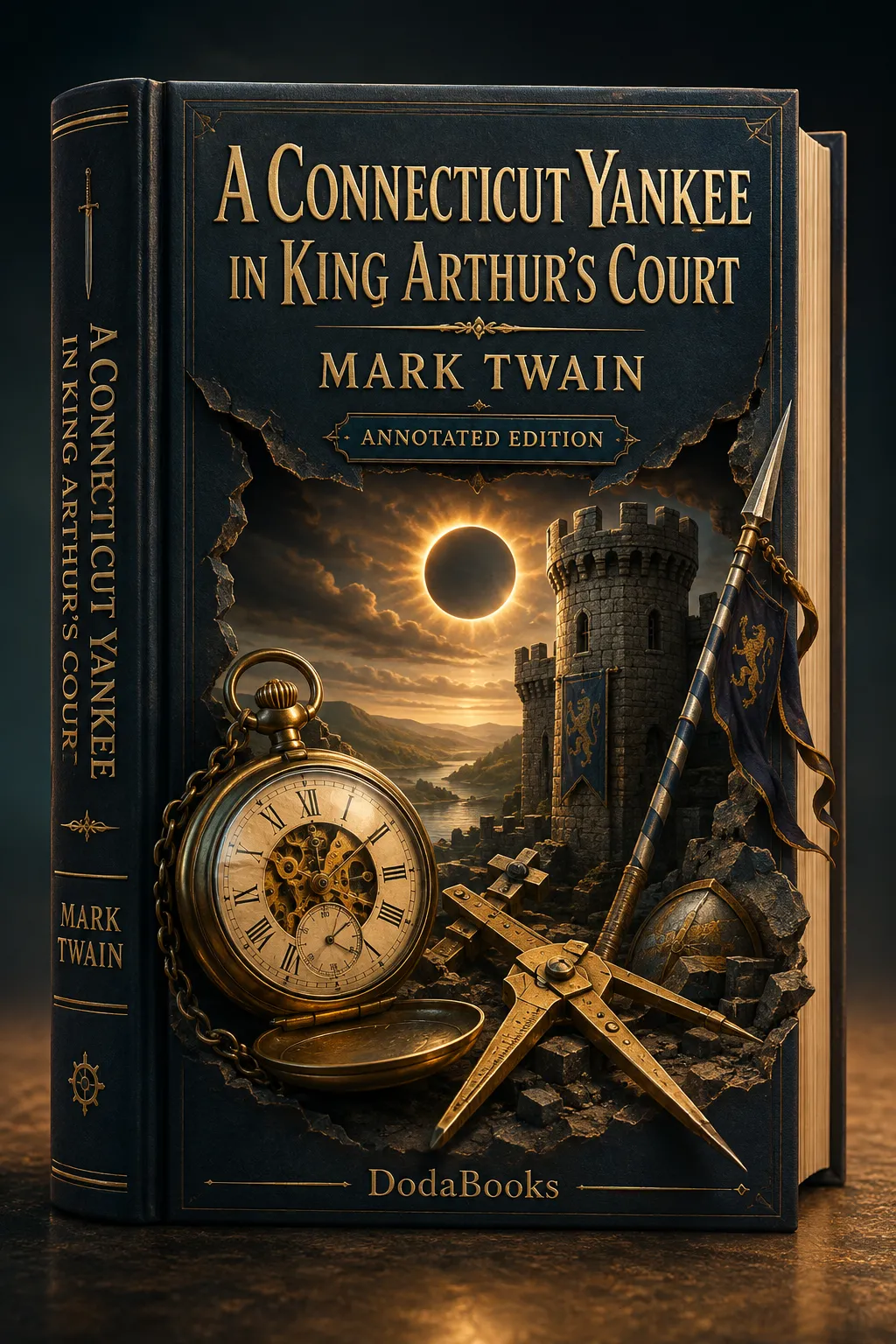
⚡ Discover the Unforgettable Characters of Mark Twain’s Epic
Unpack the brilliant psychological and political satire of Camelot’s court. The DodaBooks Annotated Edition of A Connecticut Yankee in King Arthur’s Court delivers:
- ✅ Complete Unabridged 1889 Text — Follow Hank Morgan, Arthur, Merlin, Clarence, and Sandy from beginning to end
- 📜 Exhaustive Character Annotations — Explanations of Malory’s literary models, Arthurian lore, and Gilded Age satire
- ✒️ Clear Structural Design — Elegant typography, clean margins, and readable formatting
- 🔒 100% DRM-Free Ownership — Read across your Kindle, iPad, Kobo, or PC without restrictions
- 📥 Instant EPUB Delivery — Download your digital copy immediately